Wireless Meeting Room Solutions: The 2026 Buyer's Guide to Simpler, Scalable AV
This comprehensive buyer's guide explains how modern wireless, plug-and-play meeting room solutions eliminate the high costs, complex installations, and daily technical friction associated with traditional, hardwired AV setups.
Wireless Meeting Room
Hybrid Work
Conference Room AV
Updated: Aug 19, 2026 · 10 minutes read
Global Business, Brought Near.
No Installer, No Hassle, Just Works.
In 2026, hybrid work is no longer an experimental setup—it is the operational baseline for modern businesses. Yet, a massive gap remains between what hybrid teams need and what their workspaces actually offer.
Consider this striking reality: while approximately 98% of business meetings today include at least one remote participant, less than 15% of the 87 million meeting spaces worldwide are properly equipped with video conferencing technology.
For IT managers, office administrators, and business owners, closing this gap is a top priority. However, traditional hardware setups often lead to complex installations, messy cable management, and high deployment costs.
To solve these issues, forward-thinking organizations are shifting toward modern wireless meeting room solutions. This comprehensive guide will explore how these solutions work, compare them to traditional meeting room av solutions, analyze the hidden costs of legacy hardware, and show you how to build a flexible, future-proof meeting environment.
Key Takeaways
The Hybrid Gap: While 98% of meetings now include remote participants, less than 15% of meeting spaces worldwide are properly equipped for video conferencing.
The Legacy Burden: Traditional AV integration is slow to deploy, clutters tables with cables, and costs a staggering $15,000 to $50,000 per room.
The Wireless Alternative: Modern BYOD (Bring Your Own Device) solutions wirelessly share the room’s high-quality camera and audio with a user’s laptop, eliminating technical setup delays.
Cost-Efficiency: All-in-one systems like the Nearity 360 Alien offer professional-grade 360° video and AI-driven audio for under $2,000, allowing businesses to scale across multiple rooms easily.
Smart Scalability: Center-of-table layouts with modular, daisy-chained expansion microphones ensure equal presence for all participants in huddle rooms and large boardrooms alike.
Part 1: The Frustrations of Traditional Meeting Room AV Solutions
Historically, designing a functional conference room meant hiring specialized integration firms to install complex, multi-component systems. While these legacy setups served their purpose in an era of entirely in-office teams, they present three major bottlenecks for today’s dynamic hybrid workflows.
1. Complex Installation & Cable Clutter
Traditional AV setups require a web of hardware: wall-mounted cameras, ceiling-mounted microphones, separate table hubs, and an array of HDMI, USB, and audio cables running through floors and walls.
The Mess: Tables are overrun with adapters, dongles, and power bricks.
The Construction Hassle: Deploying these setups usually requires cutting drywall, running conduits, and bringing in professional AV contractors. If you rent your office space, these permanent installations often require landlord approval and are impossible to pack up and take with you if you move.
2. The "Pre-Meeting Tax" (Setup & Troubleshooting)
We have all experienced the awkward first ten minutes of a meeting: someone trying to find the right adapter, struggling to get the camera to recognize the software, or realizing the ceiling microphone is muted.
Wasted Productivity: When meetings require extensive manual setup, teams lose valuable time.
IT Ticket Overload: Traditional systems often struggle to switch seamlessly between different meeting platforms like Zoom, Microsoft Teams, Webex, and Google Meet, resulting in constant panic calls to the IT helpdesk.
3. Rigid, Fixed Configurations
Traditional AV hardware is typically bolted down. The camera is fixed to the wall under the display, and microphones are hardwired into specific table locations.
Lack of Scalability: If you need to rearrange the room for a collaborative workshop or expand your seating capacity, your fixed AV equipment cannot adapt.
Hard to Move: You cannot easily reallocate hardware from an underutilized room to a high-demand huddle space without undergoing another round of costly de-installation and re-installation.
Part 2: The Hidden Financial Drain of Legacy AV Integration
Beyond daily operational friction, the financial impact of traditional AV integration is a major challenge for growing organizations.
Standard professional AV integration solutions start at $15,000 per room, and larger, more complex boardrooms can easily exceed $50,000. If your setup requires a dedicated, managed network infrastructure to routing video and audio streams over IP, the cost rises even higher.
For a company looking to equip 10, 20, or 50 meeting spaces across multiple regional offices, traditional AV installation is often cost-prohibitive.
Part 3: What Are Wireless Meeting Room Solutions and How Do They Work?
A wireless meeting room solution simplifies hybrid collaboration by removing the physical cables between the user's laptop and the room's display, camera, and microphone.
These systems typically leverage BYOD (Bring Your Own Device) workflows:
The Core Connection: Instead of plugging multiple cables into your laptop, your laptop connects to the room’s smart AV endpoint wirelessly or through a single USB connection.
Peripheral Sharing: The smart endpoint wirelessly shares the room's high-definition camera, speakers, and microphone array with your laptop.
Unified Execution: You launch your preferred meeting software (Zoom, Teams, Webex) directly from your device, using the room’s professional hardware to host the call.
The result is a clean, cable-free table, rapid meeting starts, and an intuitive user experience that requires zero training.
Part 4: Introducing the Nearity 360 Alien — The Ultimate Zero-Friction Solution
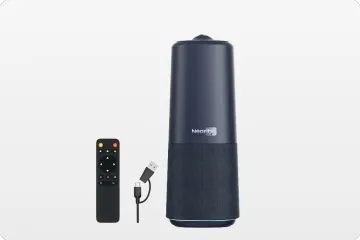
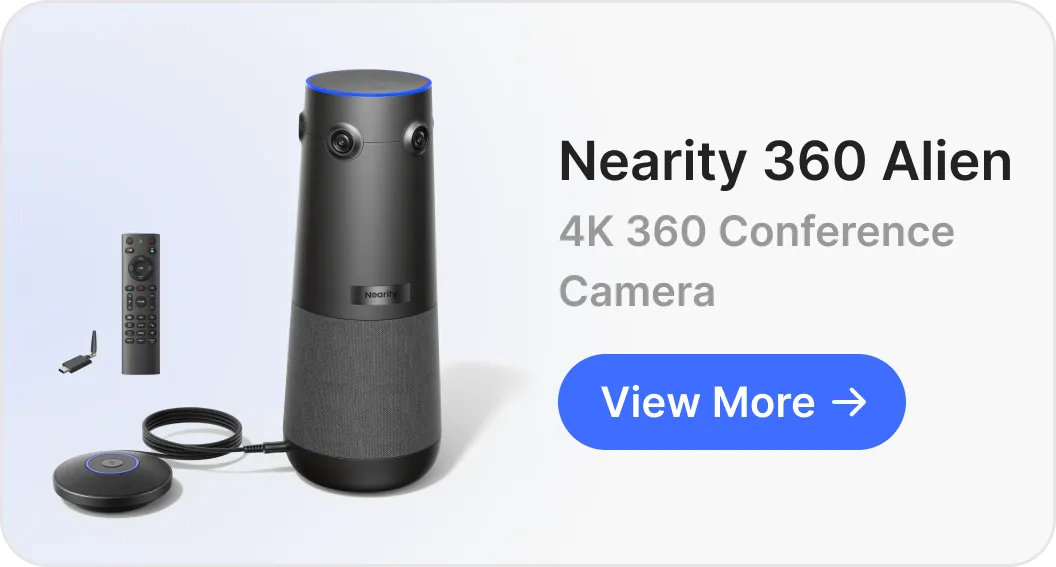
If you are looking to deploy a wireless, flexible, and cost-effective meeting environment without complex AV integration, the Nearity 360 Alien is an excellent choice.
Designed specifically to address the challenges of modern hybrid meeting spaces, the Nearity 360 Alien combines advanced audio-visual performance with a simple, plug-and-play design.
1. No Installer, No Hassle: Plug-and-Play Simplicity
Forget about drilling holes, running cables behind walls, or scheduling professional installation teams. The Nearity 360 Alien is designed for instant setup.
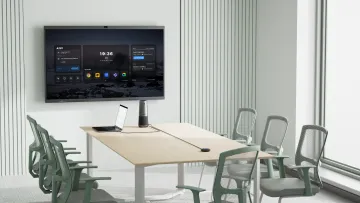
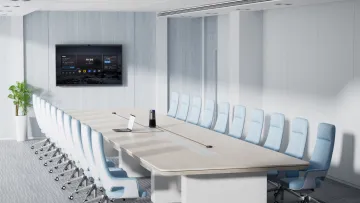
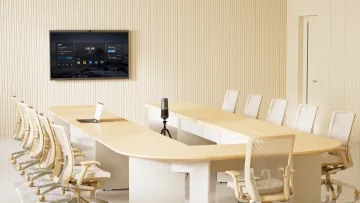
Zero Construction: Simply place the device in the center of your meeting table, plug it in, and connect it to your display or computer.
Instant Deployment: Anyone on your team can set up a professional-grade video conferencing room in under five minutes.
2. Instant Compatibility for Hassle-Free Meetings
With the Nearity 360 Alien, you can say goodbye to the "pre-meeting tax." Because it is a true plug-and-play USB device, it acts as a universal peripheral.
Platform Agnostic: It integrates seamlessly with major platforms, including Zoom, Microsoft Teams, Cisco Webex, and Google Meet.
Zero Learning Curve: Users simply sit down, plug in a single cable (or connect wirelessly), launch their chosen app, and start the meeting immediately.
3. Highly Adaptable and Scalable
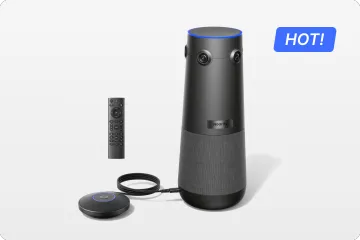
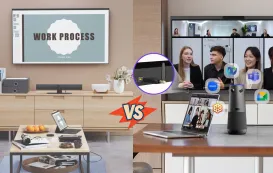
Unlike traditional wall-mounted cameras that offer a rigid, limited field of view, the Nearity 360 Alien sits in the center of the table. Its 360° panoramic True 4K camera captures everyone in the room clearly, while AI-driven facial tracking and auto-framing ensure remote participants always have a front-row seat.
Flexible Layouts: If you need to reconfigure your meeting space, simply move the compact device to your new layout.
Modular Scalability: The device features smart beamforming microphones and an integrated speaker. If you need to expand your room size, you can daisy-chain up to two expansion microphones. This allows you to scale the system effortlessly from small huddle rooms to large boardrooms.
4. Professional-Grade Quality at a Fraction of the Cost
While traditional integrated systems cost between $15,000 and $50,000, the Nearity 360 Alien Ultimate Kit is available for just $1,799.
This dramatic cost reduction allows organizations to equip all of their meeting rooms for the price of a single traditional custom setup, helping you easily bridge the hybrid meeting gap.
Part 5: Buyer's Guide: How to Evaluate Wireless Meeting Room Solutions
When choosing wireless meeting room solutions for your business, consider the following key criteria to ensure a strong return on investment (ROI):
Audio and Video Performance
Visual Clarity: Look for at least 4K resolution. In center-of-table configurations, a 360-degree lens is essential for ensuring all participants are visible without awkward camera angles.
Acoustic Intelligence: Choose systems with built-in AI noise suppression (to filter out typing, shuffling paper, or HVAC hums) and echo cancellation.
Setup Speed and Ease of Maintenance
Avoid solutions that require proprietary network infrastructures or specialized programming.
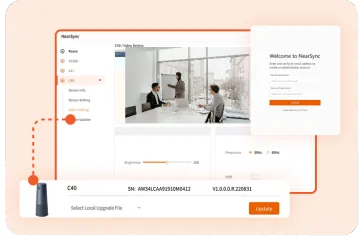
Look for systems that support automatic firmware updates and can be easily managed by your in-house IT team.
True BYOD (Bring Your Own Device) Support
Ensure your chosen hardware works with any operating system (Windows, macOS, ChromeOS) and does not lock you into a single software ecosystem.
Scalability and Future-Proofing
Meeting spaces frequently change. Choose modular hardware that can expand with daisy-chained microphones or speakers, allowing you to scale up without purchasing entirely new systems.
FAQs
1. What is a wireless meeting room solution?
A wireless meeting room solution is an integrated AV setup that allows in-room participants to connect their personal devices (laptops, tablets) to the room’s displays, cameras, and audio systems without needing physical cables running across the table. These solutions leverage local wireless networks, dedicated wireless dongles, or unified hubs to bridge the gap between user hardware and physical meeting room environments.
2. How do wireless meeting room solutions compare to traditional meeting room AV solutions?
Traditional meeting room AV solutions rely heavily on hardwired connections, extensive routing through walls or ceilings, external AV switchers, and dedicated control systems (like Crestron or Extron). They are highly reliable but extremely expensive ($15000 to over $50000 per room), require professional installation, and are rigid. Wireless meeting room solutions, by contrast, prioritize flexibility, rapid deployment, BYOD configurations, and massive cost savings (often under $2000 per room) with zero destructive construction.
3. What is BYOD, and why is it important for hybrid workspaces?
BYOD stands for Bring Your Own Device. In hybrid collaboration, a BYOD-enabled meeting room allows users to bring their own laptop into the conference room and instantly host a meeting using their preferred platform (Zoom, Teams, Webex) while utilizing the room's high-quality camera and speakerphones. It eliminates the frustration of room-bound computers, which are often locked to a single videoconferencing provider.
4. Does the Nearity 360 Alien support all major videoconferencing platforms?
Yes. The Nearity 360 Alien is fully compatible and platform-agnostic. It works seamlessly with Microsoft Teams, Zoom, Cisco Webex, Google Meet, Skype, and GoToMeeting. Because it utilizes a plug-and-play USB interface, any application that recognizes external webcam and audio sources on Windows or macOS can use the Nearity 360 Alien.
5. Can the Nearity 360 Alien cover large boardrooms, or is it only for huddle rooms?
The Nearity 360 Alien is exceptionally scalable. While its high-fidelity internal microphone array and speaker easily cover small-to-medium huddle spaces, you can daisy-chain up to two expansion microphones to extend coverage. This modular capability allows the system to easily capture crystal-clear audio in large conference rooms and executive boardrooms up to 30 feet in length.
6. What makes the 360° center-of-table camera layout better than traditional front-of-room setups?
Traditional front-of-room cameras are mounted under or above the display. This layout often creates an unnatural "bowling-alley" perspective where people sitting further away appear tiny and hard to hear. A center-of-table layout, like the Nearity 360 Alien, places the camera and smart microphone array in the physical center of the conversation. Combined with its 360 panorama and AI auto-framing, it ensures every face is perfectly visible, making remote participants feel like they are sitting directly at the table.
Final Thoughts
Traditional meeting room AV solutions were built for a world where video conferencing was the exception, not the rule. With remote participants now the norm in nearly every meeting, the businesses that adapt fastest are the ones swapping complex, fixed installations for wireless, scalable, plug-and-play systems that any team member can set up in minutes. Whether you're outfitting a single huddle room or standardizing meeting spaces across an entire office, evaluating video quality, audio coverage, platform compatibility, and total cost against your specific room sizes will point you to the right solution — without the five-figure price tag traditional AV integration usually carries.