The Ultimate Guide to Daisy Chain Speakerphones: Scalable Audio for Modern Conference Rooms
A practical guide to daisy chain speakerphone systems—how they work, why they beat single-unit setups in large rooms, and how the Nearity A20S scales seamlessly from 10-person meetings to 20+ person boardrooms.
Daisy Chain
Speakerphone
Conference Room Audio
Updated: Aug 19, 2026 · 8 minutes read
Global Business, Brought Near.
No Installer, No Hassle, Just Works.
In the era of hybrid work, the quality of your conference room audio can make or break a business meeting. We have all experienced the frustration of straining to hear a colleague at the far end of a long boardroom table, or dealing with the hollow, echo-laden sound of a single speakerphone pushed past its limits.
For IT managers, AV professionals, and business owners, finding an audio system that scales across diverse room layouts without requiring complex, expensive ceiling installations is a constant challenge.
This is where the concept of a daisy chain speakerphone becomes a game-changer.
In this comprehensive guide, we will unpack the daisy chain meaning, explain how a daisy chain conference speakerphone system works, explore its major advantages, and detail how the right system—like the Nearity A20S Conference Speakerphone—can seamlessly adapt to any space from medium meeting rooms to massive, flexible boardrooms.
Key Takeaways
Definition of Daisy Chaining: It is a wiring scheme where multiple audio devices are linked sequentially in a series, eliminating the need for each device to connect directly back to the host PC.
Smart Synchronization via DSP: Advanced Digital Signal Processing (DSP) acts as the brain of the chain, preventing echo, canceling noise, and managing microphone gating across all connected units.
Key Advantages: Daisy-chained systems offer cost-effective scalability, zero-renovation installation, even audio distribution, and flexibility for modular workspaces.
Ideal Use Cases: Essential for conference tables exceeding 12–14 feet, irregular or U-shaped room layouts, and high-echo environments (like glass-walled rooms).
Enterprise-Grade Solution: The Nearity A20S supports daisy-chaining up to 6 units, utilizing AI-powered algorithms to seamlessly cover massive executive boardrooms up to 500+ sq ft.
What is Daisy Chaining? Understanding the Basics
Before diving into hardware specifics, it is essential to answer a fundamental question: what is daisy chaining, and what does it mean in the context of professional audio-visual (AV) setups?
The Daisy Chain Meaning
In electrical and electronic engineering, daisy chain refers to a wiring scheme in which multiple devices are linked together in sequence or in a ring, one after the other. Instead of every individual device routing a dedicated cable all the way back to a central host computer or network switch, device A plugs into device B, device B plugs into device C, and only the first (or last) device connects directly to the host source.
The term itself is a charming metaphor inspired by the childhood activity of weaving daisies together by their stems to create a continuous chain of flowers.
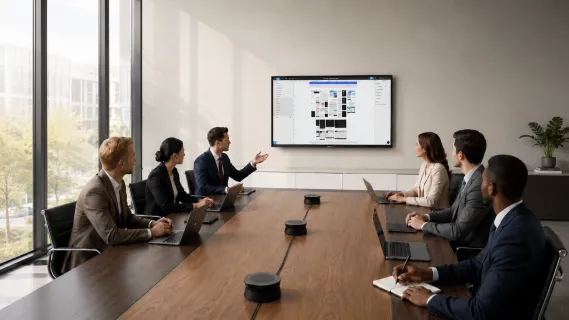
When applied to conference room hardware, a daisy chain speakerphone system consists of a primary (or master) unit connected to your meeting room computer, with secondary (or satellite) units connected sequentially to expand both the microphone pickup range and the speaker output volume.
How Does a Daisy Chain Conference Speakerphone Work?
A single, standard speakerphone houses a set of microphones and a speaker. While highly effective for small huddle rooms or personal desks, its acoustic reach is physically limited. If you place a single unit in the center of a 20-foot table, participants sitting at the far ends will sound distant, muffled, or completely drop out of the conversation.
A daisy chain conference speakerphone system overcomes this physical limitation by distributing the audio capture and broadcasting points across the room. Here is a breakdown of how the technology works under the hood:
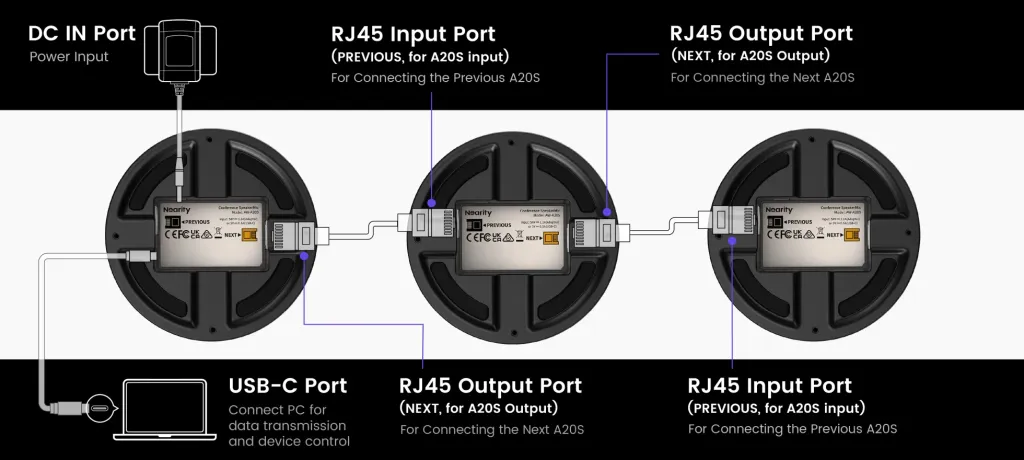
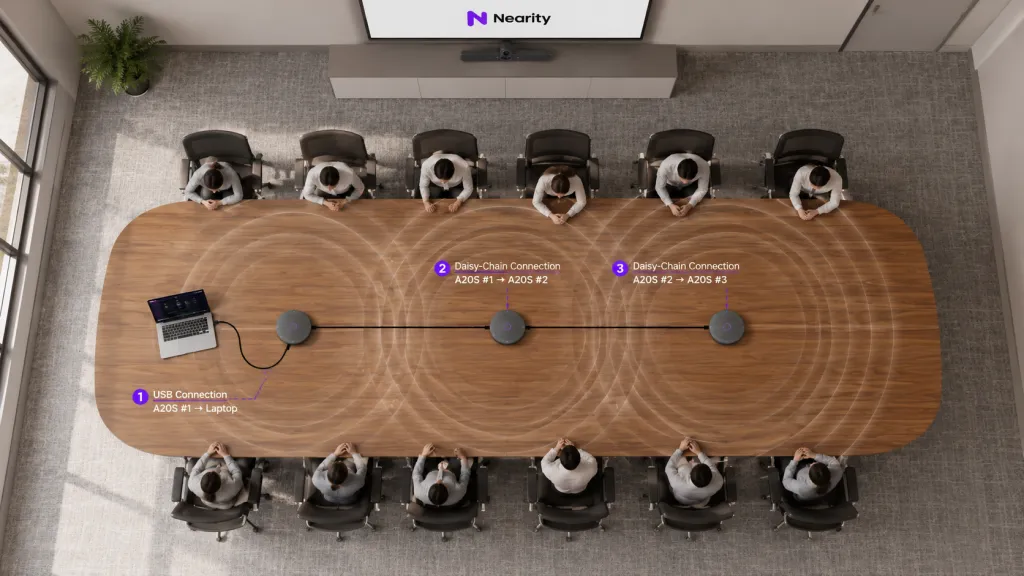
Sequential Data & Audio Transmission: The main speakerphone connects to the laptop or in-room PC via USB. Using specialized daisy-chain cables (often proprietary or high-grade Ethernet cables like Cat6), auxiliary speakerphones are linked in a series.
Bi-Directional Audio Routing: The system intelligently routes incoming audio (the voices of remote participants) to all connected speakers simultaneously, ensuring everyone in the physical room hears the remote side clearly. Concurrently, it collects outgoing audio (the voices of local participants) from all active microphones.
Smart Synchronization & DSP: Advanced Digital Signal Processing (DSP) is the brain of a daisy-chained system. Without it, linking multiple microphones and speakers in the same room would cause massive acoustic echo, feedback loops, and chaotic background noise. The DSP dynamically manages echo cancellation, noise suppression, and microphone gating across the entire chain, treating the collection of physical units as a single, unified audio ecosystem.
The Benefits of Daisy Chain Speakerphones
For procurement teams and facility managers, investing in daisy-chainable technology offers several clear advantages over traditional, fixed audio installations.
Cost-Effective Scalability
Rather than purchasing different, expensive audio systems for every unique room shape in your office, you can standardize on a single speakerphone model. For small rooms, deploy one unit. For larger spaces, simply purchase additional units and link them together. This dramatically reduces hardware sourcing and inventory management complexities.
Zero-Renovation Installation
Traditional high-end conference audio often requires cutting into drywall to run analog wires to ceiling microphones or wall-mounted speakers. Daisy chain speakerphones sit elegantly on the tabletop. The cables run directly from unit to unit—often easily concealed within standard table cable tracks—eliminating the need for expensive AV installers or structural room renovations.
Superior Audio Distribution
With a single central speakerphone, people close to the unit find the volume uncomfortably loud, while those far away struggle to hear. Daisy chaining distributes both the speakers and the microphones evenly. This ensures a consistent volume level throughout the room and guarantees that every speaker's voice is captured at a native, high-fidelity level.
Flex-Space Friendly
Modern offices frequently feature movable partition walls that combine two medium-sized rooms into a single large event space. A daisy-chained system can be physically split into individual units for separate rooms on a typical Tuesday, and chained together into a grand, unified system for an all-hands meeting on Friday.
When Do You Need a Daisy Chain System?
How do you determine if your business needs a daisy chain conference speakerphone, or if a single unit will suffice? Ask yourself the following questions:
What is the length of your conference table? If your meeting table exceeds 12 to 14 feet (typically seating more than 6–8 people), a single speakerphone will struggle to cover the perimeter.
What is the room shape? Long, narrow boardrooms or U-shaped layout tables are notorious for creating acoustic blind spots. A chain of speakerphones can trace the physical geometry of the table.
How are the acoustics? Rooms with glass walls, hard floors, and high ceilings generate significant echo. Distributing microphones closer to the physical participants reduces the amount of ambient room reflection captured, significantly improving voice clarity for remote listeners.
Scalable Conference Audio: How the Nearity A20S Adapts to Every Room Size
If you are looking for a reliable, enterprise-grade system that perfectly exemplifies the power of daisy chaining, the Nearity A20S Conference Speakerphone is an industry-leading solution.
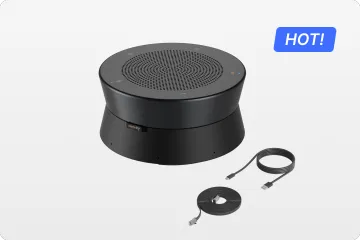
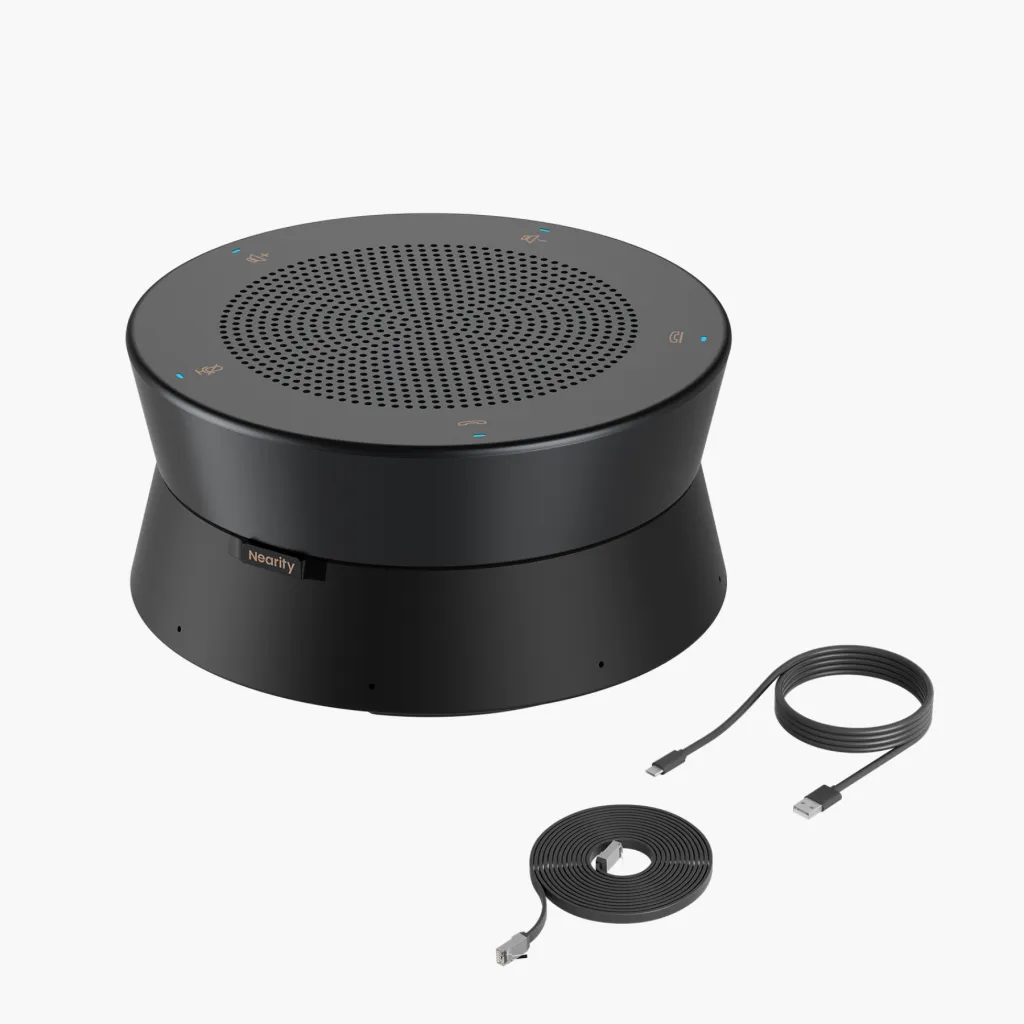
Designed for versatility, the A20S combines an advanced 8-element omnidirectional microphone array, a high-fidelity speaker, and state-of-the-art AI-powered noise suppression. Crucially, the A20S features seamless daisy-chaining capabilities that allow it to adapt to different room configurations.
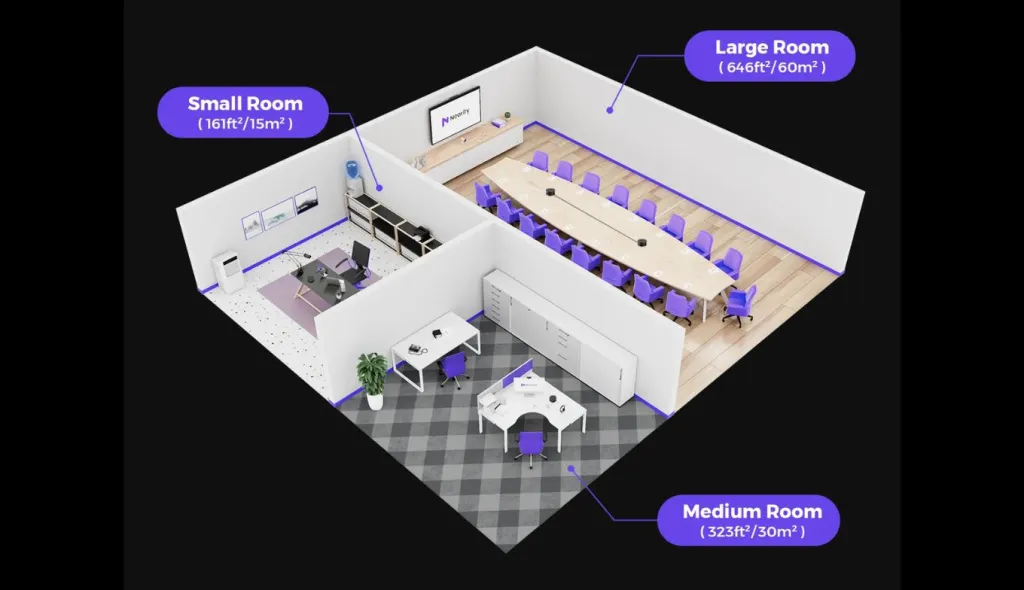
Below, we detail how the Nearity A20S can be daisy-chained to solve the audio needs of various room sizes:
Master A20S connected to PC via USB; Satellite A20S units linked in series using standard RJ45 (Ethernet) cables.
Extends the audio pickup and broadcast range up to 15 meters, ensuring everyone at a long boardroom table is heard clearly.
Very Large / Boardroom / Flexible Space (20+ People)
Up to 6 x Nearity A20S (Daisy Chained)
Master A20S linked to up to 6 additional A20S units sequentially.
Comprehensive coverage for complex U-shaped or modular layouts, managing audio seamlessly with zero lag or echo.
The Power of Proprietary DSP in the A20S Chain
When daisy-chaining up to six A20S units, Nearity’s advanced deep-learning AI algorithms work in perfect synchronization. The system intelligently detects which unit is closest to the active speaker, automatically focusing the beamforming microphones on that individual while attenuating the background noise picked up by the other four units. The result is a crystal-clear, professional-grade audio experience that makes remote participants feel like they are sitting in the room.
Limitations to Keep in Mind
While daisy-chaining is an excellent solution for most businesses, there are a couple of limitations to consider:
Cable Management: Because the units are physically linked, you will have cables running between the speakerphones. Utilizing tabletop cable grommets, adhesive clips, or under-table tracks is highly recommended to keep the workspace clean and professional.
Maximum Chain Limits: You cannot chain devices indefinitely. Most manufacturers set a hard limit on how many units can be linked due to power and bandwidth constraints. For instance, the Nearity A20S supports daisy-chaining of up to 6 units, which is more than enough to cover even exceptionally large or awkwardly shaped executive boardrooms.
FAQs
1. How many A20S units can I daisy chain together?
The A20S supports up to six units per chain, which Nearity rates for rooms up to 500+ sq ft (50+ m²) with more than 20 participants. Six units connected via standard PoE Ethernet cables form a single logical device on your computer.
2. Can I use daisy chained speakerphones with Microsoft Teams or Zoom without extra certification?
The Nearity A20S is compatible with Microsoft Teams, Zoom, Google Meet, Webex, GoTo Meeting, and most other major UC platforms out of the box. No additional certification or software is required — the device presents as a standard USB audio class device.
3. What cables do I need between units?
Standard Ethernet cables (included in the A20S box) connect between the "Next" port of one unit and the "Previous" port of the next. For longer runs across a large boardroom table, Cat 5e or Cat 6 cables of any length up to typical Ethernet limits (100 m) will work.
4. Is a daisy chain speakerphone better than a ceiling microphone system for large rooms?
It depends on your priorities. A ceiling system offers a clean aesthetic and no table-level hardware, but typically requires professional installation, significant upfront cost, and room-specific engineering. A daisy chain speakerphone system like the A20S can be deployed by any IT generalist in minutes, relocated as needed, and expanded incrementally — making it the more practical choice for most commercial office environments.
5. Can I mix and match different brands or models in a daisy chain?
No. Because daisy-chaining relies on highly synchronized acoustic cancellation and proprietary digital signal processing (DSP) to prevent echo, you must use identical models of the same brand. Mixing different hardware will prevent the software from balancing the microphones and speakers properly, resulting in severe audio feedback and connection failures.
Conclusion: Elevate Your Meeting Equity
In modern business, "meeting equity" is the goal—ensuring that every participant, whether physical or remote, has an equal opportunity to hear, be heard, and contribute to the conversation.
Understanding what is daisy chaining and implementing a robust daisy chain speakerphone system is one of the most effective, scalable, and budget-friendly ways to achieve this equity in medium and large rooms. By moving the microphones and speakers closer to your team, you eliminate acoustic barriers and elevate collaboration.
With its premium AI audio processing, plug-and-play simplicity, and the flexibility to scale from a single unit to a five-device chain, the Nearity A20S Speakerphone stands out as an exceptional investment for forward-thinking IT and facilities teams.