

















































Remote work is no longer a temporary workplace experiment. It has become a long-term business strategy, a talent-retention tool, and one of the biggest debates in modern workforce management.
But the real question is not simply whether people like working from home. The bigger question is: does remote work actually improve productivity?
The answer is more nuanced than “remote is better” or “office is better.” The latest remote work productivity statistics show that employees can be highly productive outside the office, especially when they have clear goals, flexible schedules, and the right collaboration tools. At the same time, remote work can create new challenges, including burnout, isolation, communication gaps, and poor meeting quality.
In this guide, we’ll break down the most important remote work productivity statistics, broader remote work statistics, and key work from home statistics that business leaders, HR teams, and remote employees should know in 2026.
Key Takeaways
- Measurable Gains: Structured remote roles can see a 13% performance increase due to quieter environments and more minutes worked.
- Retention is Key: 46% of employees are unlikely to stay at a job that removes remote work flexibility.
- Hybrid Dominance: 52% of remote-capable workers have settled into a hybrid model, averaging 2.3 days per week in the office.
- Trust Gap: "Productivity Paranoia" exists, where 87% of employees feel productive while only 15% of leaders feel confident in that output.
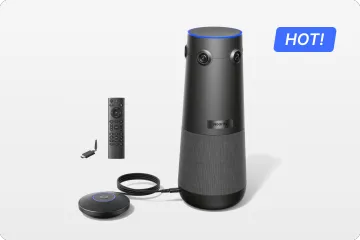
- Tools Matter: High-quality audio and 360° video equipment (like the Nearity 360 Alien) are critical for preventing communication fatigue in hybrid teams.
Key Remote Work Productivity Statistics at a Glance

Before diving deeper, here are some of the most important statistics shaping the future of remote and hybrid work:
| Remote Work Statistic | What It Means |
|---|---|
| Home working led to a 13% performance increase in a Stanford-backed Ctrip experiment. | Remote work can improve measurable output in structured roles. |
| Hybrid work had no negative impact on productivity or promotion rates in a large Trip.com experiment. | Hybrid work can maintain performance while improving retention. |
| Resignations fell by about one-third among workers who shifted from full-time office work to a hybrid schedule. | Flexibility can reduce turnover. |
| BLS found a positive association between remote work growth and total factor productivity growth across industries. | Remote work may improve business efficiency beyond individual output. |
| 52% of remote-capable U.S. employees work hybrid, while 26% work fully remote. | Hybrid work has become the dominant model for remote-capable employees. |
| Hybrid workers spend about 2.3 days per week in the office. | Many companies are settling into a balanced hybrid schedule. |
| 46% of remote-capable workers say they would be unlikely to stay if they could no longer work from home. | Remote work is strongly tied to employee retention. |
| 13.3% of U.S. workers worked from home in 2024, still far above pre-pandemic levels. | Work from home remains a lasting part of the labor market. |
A Stanford/NBER experiment with Ctrip employees found that working from home led to a 13% performance increase, with gains coming from both more minutes worked and more calls handled per minute. A later Stanford study on hybrid work found that employees working from home two days a week were just as productive and just as likely to be promoted as fully office-based peers, while resignations fell by about one-third.
Remote Work Statistics: Remote and Hybrid Work Are Here to Stay

The first major trend is clear: remote work is no longer unusual.
According to Gallup, among remote-capable U.S. employees, 52% work hybrid, 26% work exclusively remote, and 21% work fully on-site. Gallup also reports that hybrid workers spend about 46% of their workweek in the office, equal to around 2.3 days per week.
This shows that hybrid work has become the middle ground between fully remote and fully office-based work. Many companies no longer treat remote work as an emergency policy. Instead, they are building formal hybrid schedules around collaboration, office space, employee retention, and productivity.
The U.S. Census Bureau also shows that working from home remains much more common than it was before the pandemic. In 2024, 13.3% of workers worked from home, compared with 13.8% in 2023. This is lower than the pandemic peak but still significantly higher than pre-pandemic levels.
In other words, remote work has stabilized. It may not look the same as it did in 2020 or 2021, but it is not disappearing.
Remote Work Productivity Statistics: Are Remote Workers More Productive?

One of the most cited remote work productivity statistics comes from the Stanford/NBER Ctrip experiment. In that study, call center employees who worked from home saw a 13% performance increase compared with office-based employees. About 9 percentage points came from working more minutes per shift, while about 4 percentage points came from handling more calls per minute in a quieter environment.
This does not mean every employee in every role will automatically be 13% more productive at home. The Ctrip study focused on call center employees, whose work could be clearly measured. However, it does prove an important point: when the role is structured, measurable, and supported by the right systems, working from home can improve output.
For knowledge workers, the picture is more complex. Stanford’s research on hybrid work found that working from home two days per week had no negative effect on productivity or career advancement, while improving retention.
That makes hybrid work especially attractive for companies. Employees get flexibility, companies maintain performance, and both sides benefit from lower turnover.
Why Hybrid Work May Be the Productivity Sweet Spot
Fully remote work can be effective, especially for independent work, writing, coding, analysis, customer support, and other focused tasks. But for many companies, hybrid work may offer the best balance.
Hybrid work gives employees quiet time for deep work at home while preserving in-person time for brainstorming, training, team bonding, and complex collaboration.
Stanford’s 2025 global research found that working from home levels have stabilized after falling from their pandemic highs. The global average declined from 1.6 days per week in 2022 to 1.33 days in 2023, then stabilized around 1.27 days in 2024/2025.
The same Stanford report notes that hybrid working from home can be profitable for companies because it reduces recruitment and retention costs without reducing productivity.
For business leaders, this means the real question is not “remote or office?” The better question is: which tasks should happen remotely, and which tasks are better done in person?
A practical hybrid model might look like this:
| Work Type | Best Location |
|---|---|
| Deep focus work | Home or quiet remote workspace |
| One-on-one calls | Remote |
| Status updates | Remote or asynchronous |
| Brainstorming | Office or high-quality hybrid meeting room |
| Client presentations | Office, hybrid meeting room, or professional video setup |
| Training and onboarding | Hybrid or in person |
| Team bonding | In person |
Work From Home Statistics: What Employees Actually Want
Work from home statistics also show that flexibility is now a major factor in employee retention.
According to Pew Research Center, among employed adults with jobs that can be done from home, 75% work remotely at least some of the time. Pew also found that 46% of workers in this group say they would be unlikely to stay at their current job if their employer no longer allowed them to work from home.
This is important for employers. Remote work is not just a convenience. For many employees, it has become part of how they evaluate job quality.
Pew also found that among hybrid workers, 72% would choose a hybrid arrangement if they had the choice. This suggests that many employees do not necessarily want to be fully remote forever. Instead, they want flexibility and control over where they work.
For companies competing for talent, this matters. A strict return-to-office policy may not only affect employee satisfaction. It may also increase turnover risk.
The Business Case for Remote Work Productivity
Remote work productivity is not only about whether an employee completes more tasks in a day. It also affects broader business performance.
The U.S. Bureau of Labor Statistics found a positive relationship between remote work and total factor productivity across 61 private-sector industries. From 2019 to 2021, a one-percentage-point increase in remote workers was associated with a 0.08 percentage-point increase in total factor productivity growth. For 2019 to 2022, the association was 0.09 percentage points.
This does not prove that remote work alone causes productivity growth. However, it suggests that remote work can contribute to business efficiency when companies reduce office costs, improve hiring flexibility, lower turnover, and use digital workflows more effectively.
For example, remote and hybrid work can help companies:
- Reduce real estate and office operating costs
- Recruit from a wider talent pool
- Improve employee retention
- Reduce commute-related stress
- Support more flexible schedules
- Improve focus time for individual work
- Build more resilient distributed teams
The key is that remote work must be managed intentionally. Without clear expectations, good communication systems, and reliable meeting technology, the productivity benefits can quickly disappear.
The Hidden Challenges Behind Remote Work Productivity
Remote work can improve productivity, but it also creates new risks. Companies that ignore these risks may see engagement, trust, and collaboration suffer over time.
1. Burnout and Overwork
One common problem with remote work is that the boundary between work and personal life becomes harder to maintain.
Buffer’s 2023 State of Remote Work report found that 44% of remote workers said they worked more than the previous year, and 22% said not being able to unplug was one of their biggest struggles.
This is why remote work productivity should not be measured only by hours online. If employees are working longer but burning out faster, the productivity gain is not sustainable.
To prevent burnout, companies should encourage:
- Clear working hours
- Meeting-free focus blocks
- Reasonable response-time expectations
- Asynchronous communication
- Regular breaks
- Output-based performance reviews
Remote work should create flexibility, not an always-on culture.
2. Isolation and Weak Team Connection
Remote workers may be productive individually but feel disconnected from the team.
Buffer found that loneliness and staying home too often were among the top struggles remote workers reported. This is especially relevant for fully remote teams, new hires, and employees who live alone.
The solution is not necessarily forcing everyone back to the office full time. Instead, companies should design intentional connection points, such as:
- Weekly team check-ins
- Monthly in-person collaboration days
- Virtual coffee chats
- Clear onboarding programs
- Team rituals that are not only task-focused
Productivity depends on focus, but long-term performance also depends on trust and belonging.
3. Communication Gaps
Remote work often exposes weak communication systems. If a company relies on hallway conversations, unclear task ownership, or constant meetings, remote work can feel chaotic.
High-performing remote teams usually share three habits:
- They document important decisions.
- They define ownership clearly.
- They reduce unnecessary meetings.
Instead of asking, “Did everyone attend the meeting?” remote-first teams ask, “Does everyone know what decision was made, who owns the next step, and when it is due?”
That shift from presence to clarity is essential for remote work productivity.
4. Productivity Paranoia
One of the biggest challenges in remote and hybrid work is trust.
Microsoft’s Work Trend Index described this problem as “productivity paranoia”: employees believe they are productive, while many leaders worry they are not. Microsoft reported that 87% of employees said they were productive, while 85% of leaders said hybrid work made it challenging to feel confident that employees were being productive.
This trust gap can lead to excessive monitoring, unnecessary check-ins, and return-to-office mandates that may reduce morale.
The better solution is to measure outcomes, not screen time. Companies should define productivity through:
- Completed projects
- Customer response times
- Sales results
- Quality of work
- Team contribution
- Business impact
Remote work does not work well when managers try to recreate the office through surveillance. It works best when teams have clear goals and accountability.
Meeting Quality Is a Remote Work Productivity Issue

Many companies talk about remote work productivity in terms of schedules, software, and employee behavior. But one factor is often overlooked: meeting quality.
Remote and hybrid teams depend heavily on video meetings. If the audio is unclear, the camera angle is poor, or remote participants cannot follow the conversation, productivity drops quickly.
Poor meeting quality can lead to:
- Repeated questions
- Misunderstandings
- Longer meetings
- Lower engagement
- More follow-up calls
- Remote employees feeling excluded
- Slower decision-making
This is especially common in hybrid meetings, where some people are in a conference room and others join remotely. If the meeting room camera only shows part of the table, remote participants may miss body language and side discussions. If the microphone cannot clearly capture everyone, remote workers may struggle to follow the conversation.
That is why improving meeting-room technology is a practical way to improve remote work productivity.
How to Improve Remote Work Productivity in Hybrid Teams

Remote work productivity does not happen automatically. It requires the right mix of management, culture, tools, and workplace design.
Here are five practical ways companies can improve productivity in remote and hybrid teams.
1. Set Clear Output-Based Goals
Remote teams need clarity. Every employee should know:
- What they are responsible for
- How success will be measured
- Which tasks are urgent
- Who owns each decision
- When work is due
This reduces the need for constant check-ins and helps employees focus on meaningful work.
2. Use Asynchronous Communication
Not every update needs a meeting. Asynchronous communication helps distributed teams stay aligned without interrupting deep work.
Use async communication for:
- Status updates
- Project documentation
- Meeting notes
- Decision records
- Task handoffs
- Weekly progress reports
Save live meetings for discussion, problem-solving, relationship-building, and decisions that truly require real-time input.
3. Design Better Hybrid Meetings
Hybrid meetings should not feel like office-first meetings with remote participants watching from the outside.
To make hybrid meetings more productive:
- Use a wide-angle or 360° camera
- Make sure every speaker can be heard clearly
- Share agendas before meetings
- Assign a meeting owner
- Summarize decisions afterward
- Avoid side conversations that remote participants cannot hear
- Use screen sharing and shared documents
The goal is to make every participant, whether in the room or remote, feel equally included.
4. Upgrade Audio and Video Equipment
Laptop cameras and built-in microphones may be enough for casual one-on-one calls. But for client meetings, team discussions, training sessions, and hybrid conference rooms, dedicated meeting equipment can make a major difference.
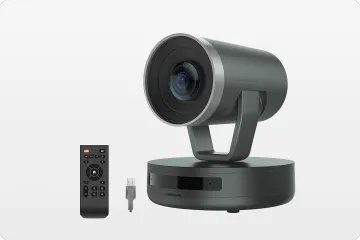
For example, a 360° conference camera can capture everyone around the table, while a professional video conferencing camera can improve image clarity, framing, and audio pickup. This helps remote participants follow the conversation more naturally and reduces wasted time caused by poor communication.
For hybrid teams, products like the Nearity 360 Alien, Nearity C50, Nearity V30S, and Nearity A20S can help improve meeting clarity and participation:
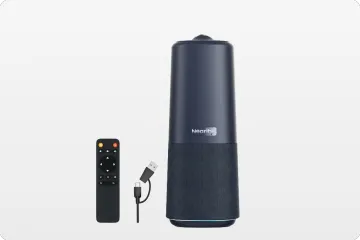
- Nearity 360 Alien: A 360° all-in-one conference camera designed for hybrid meetings where multiple people sit around the table.
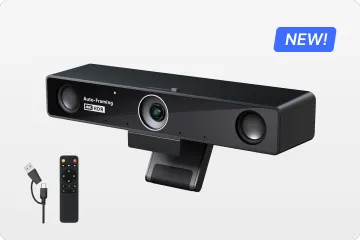
- Nearity C50: An all-in-one meeting camera for group collaboration and small to medium meeting rooms.
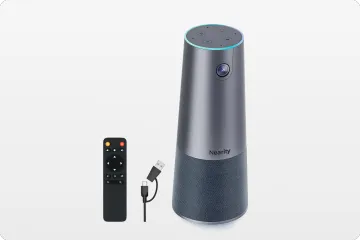
- Nearity V30S: A 4K webcam for professionals who need clearer video in remote meetings.
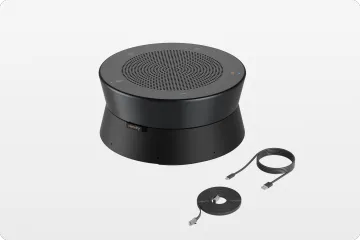
- Nearity A20S: A speakerphone for teams that need clearer audio and better voice pickup in meeting rooms.
Better equipment will not fix every productivity problem, but it can remove one of the most common barriers in hybrid work: unclear communication.
5. Protect Focus Time
Remote work productivity often depends on deep focus. If employees spend the whole day switching between messages, meetings, and urgent requests, they may feel busy without producing meaningful results.
Companies can protect focus time by:
- Creating meeting-free blocks
- Limiting recurring meetings
- Encouraging written updates
- Reducing unnecessary notifications
- Letting employees choose their most productive work hours
- Separating collaboration time from deep work time
The best remote teams do not simply work from different places. They work with better systems.
Remote Work Productivity by Role: Who Benefits Most?

Remote work does not affect every role in the same way. In general, jobs that are digital, measurable, and independent are easier to perform remotely. This includes roles such as software development, customer support, digital marketing, content writing, finance analysis, accounting, data analysis, design, sales development, administrative support, online education, and consulting.
Hybrid work is often a better fit for roles that require both focused individual work and regular collaboration, such as product management, HR and recruiting, client success, team leadership, strategy, creative work, training, onboarding, and cross-functional project management.
By contrast, roles that depend heavily on physical presence, specialized equipment, or on-site service usually require more in-person work. This includes healthcare delivery, manufacturing, logistics, lab research, retail, hospitality, facility management, and field services.
The takeaway is simple: remote work productivity depends on job design. Companies should avoid one-size-fits-all policies and instead match work location to role requirements.
Remote Work vs. Work From Home: What’s the Difference?

People often use “remote work” and “work from home” as if they mean the same thing, but there is a difference.
Remote work is a broader term. It means working outside a traditional company office. A remote worker might work from home, a coworking space, a client site, a hotel, or another city.
Work from home is more specific. It means the employee is working from their home office, kitchen table, bedroom, or another space inside their home.
This difference matters for SEO and for business strategy. Remote work statistics may include hybrid workers, digital nomads, and employees working from many locations. Work from home statistics focus specifically on home-based work.
For companies, this distinction affects equipment, security, communication, and employee support. A home-based employee may need a better webcam, headset, chair, and monitor. A hybrid employee may need both a good home setup and high-quality conference room equipment at the office.
What These Remote Work Productivity Statistics Mean for Companies
The latest remote work productivity statistics point to one clear conclusion: remote and hybrid work can be productive, but only when they are intentionally managed.
Remote work succeeds when companies provide:
- Clear expectations
- Output-based performance metrics
- Strong documentation
- Trust-based management
- Effective communication tools
- High-quality video meeting equipment
- Healthy boundaries
- Intentional team connection
Remote work struggles when companies rely on:
- Constant meetings
- Vague goals
- Poor documentation
- Weak managers
- Low-quality audio and video
- Surveillance-based productivity tracking
- Unclear hybrid schedules
The future of work is not about choosing between home and office. It is about designing better workflows for distributed teams.
Conclusion: Remote Work Productivity Depends on How Work Is Designed
Remote work is not a magic productivity solution, but it is also not a productivity threat by default.
The data shows that working from home can improve performance in structured roles, hybrid work can maintain productivity while improving retention, and remote-capable employees strongly value flexibility. At the same time, remote work can create challenges around burnout, isolation, communication, and trust.
For business leaders, the lesson is clear: productivity depends less on where employees sit and more on how work is managed.
Companies that want to improve remote work productivity should focus on clear goals, better communication, fewer unnecessary meetings, and professional hybrid meeting setups. When employees have the right structure and the right tools, remote and hybrid work can become a long-term advantage rather than a temporary compromise.
FAQs
1. How can video conferencing equipment improve remote work productivity?
Video conferencing equipment improves remote work productivity by making communication clearer and reducing the time wasted on repeated questions, poor audio, unclear images, and follow-up meetings. For hybrid teams, a professional meeting camera or speakerphone can help remote participants follow discussions more easily and feel more included.
2. Are 360° conference cameras useful for hybrid meetings?
Yes. A 360° conference camera is especially useful for hybrid meetings where several people sit around the same table while others join remotely. Instead of showing only one side of the room, a 360° camera can capture everyone more naturally, helping remote participants see who is speaking and follow the conversation more easily. This makes products like the Nearity 360 Alien a good fit for collaborative hybrid meeting spaces.

3. How can companies improve remote work productivity in meeting rooms?
Companies can improve remote work productivity in meeting rooms by using clear audio, wide-angle or 360° video, stable connectivity, and meeting tools that help remote participants feel included. Instead of relying only on laptop cameras and built-in microphones, hybrid teams should consider dedicated meeting room devices that are designed for group conversations.