The line between office work and remote work has disappeared—but headset marketing hasn't caught up. If you split your time between home, the office, and everywhere in between, choosing a headset based on outdated categories could leave you with the wrong tool for the job. This guide explains why hybrid professionals need a different approach and reveals the key features to look for in a headset built for today's flexible workstyle.
Office Headsets vs. Work From Home Headsets: Same Job, Different Rules
The marketing industry has spent the last five years selling you a false dichotomy. Browse any headset manufacturer's website and you'll find neatly categorized products: "Office Headsets" for corporate environments, "Work From Home Headsets" for remote workers, sometimes even "Gaming Headsets" and "Travel Headsets" for good measure. This categorization makes for clean website navigation, but it fundamentally misrepresents how modern professionals actually work.
The reality that manufacturers haven't caught up with: most knowledge workers no longer exist exclusively in either category. The hybrid worker—spending two days at home, three in the office, occasionally at a coffee shop or airport—has become the dominant work pattern across industries. This worker needs a headset that performs in a quiet home office on Tuesday, a bustling open floor on Wednesday, and a cramped airplane seat on Thursday. No single category label captures this requirement because the need itself spans categories.

What we're really looking for isn't an "office headset" or a "WFH headset"—it's a hybrid headset, even if that category doesn't officially exist yet. This article reframes the discussion around the actual needs of hybrid workers and examines what features matter when your work environment changes daily.
Why "Office" and "WFH" Categories Break Down
The Office Environment: Controlled Chaos
Corporate offices present a paradox: they're professionally managed environments that are acoustically terrible for calls. Open floor plans designed for collaboration create a background noise soup of side conversations, phone rings, keyboard clicks, and foot traffic. The acoustic treatment that would make these spaces functional—sound-absorbing panels, ceiling baffles, carpet—is often sacrificed for aesthetic minimalism.
Office headsets traditionally prioritize durability and IT manageability. They need to withstand rough handling, integrate with corporate phone systems, and comply with IT security policies. But the noise challenge in modern offices is so severe that microphone noise cancellation has become equally important. A headset that survives five years of desk drops but transmits office chatter to your callers isn't serving its primary purpose.
The Home Environment: Unpredictable Acoustics
Home offices present the inverse challenge: acoustically varied environments that are individually manageable but collectively unpredictable. Your home office might be perfectly quiet 80% of the time, but that remaining 20%—the doorbell, the dog, the neighbor's lawn mower, the kids arriving home—creates interruptions that are both more jarring and more personal than office noise.
Work from home headsets traditionally prioritize comfort and ease of setup. They assume you're managing your own technology without IT support, so plug-and-play connectivity is essential. But the noise cancellation requirements for home offices can actually exceed those of corporate offices because home noise is more variable and less predictable than the steady hum of an open floor plan.
The Hybrid Gap: Neither Category Fully Fits
The hybrid worker needs office-grade durability and noise handling combined with home-grade comfort and setup simplicity. They need a headset that handles both the consistent low-frequency drone of office HVAC and the sudden, unpredictable noises of home life. They need IT-friendly connectivity that also works seamlessly with personal devices. No single category captures this, which is why hybrid workers should evaluate headsets against their actual usage pattern rather than marketing labels.
This shift is supported by research from Stanford economist Nicholas Bloom and colleagues, whose large-scale hybrid work study found that employees working in hybrid arrangements reported higher job satisfaction and lower turnover without sacrificing performance. As hybrid work becomes the norm, professionals increasingly need equipment that adapts seamlessly to multiple work environments.
Scenario: A Week in Hybrid Work Audio
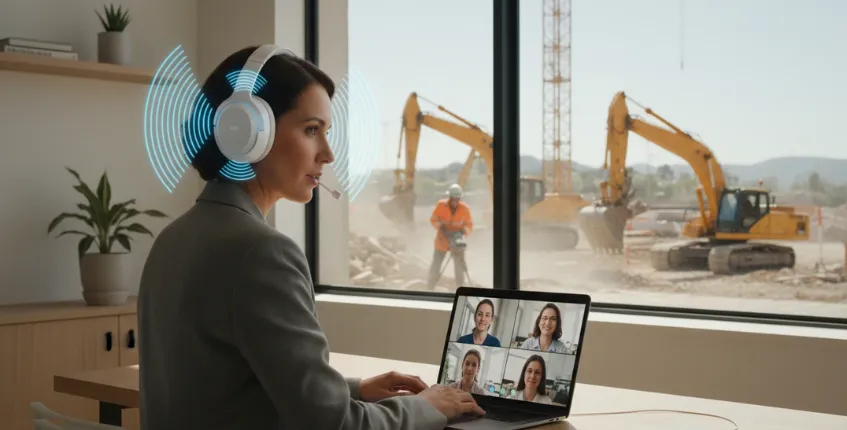
- Monday (Home): Quiet morning until the 11 AM construction starts across the street. Jackhammer noise penetrates your closed windows. You're on a client call. Your headset's ENC suppresses the construction noise; your client hears nothing unusual. At 2 PM, your kids arrive home from school. The dog barks. You hit the mute button instantly. The call continues without disruption.
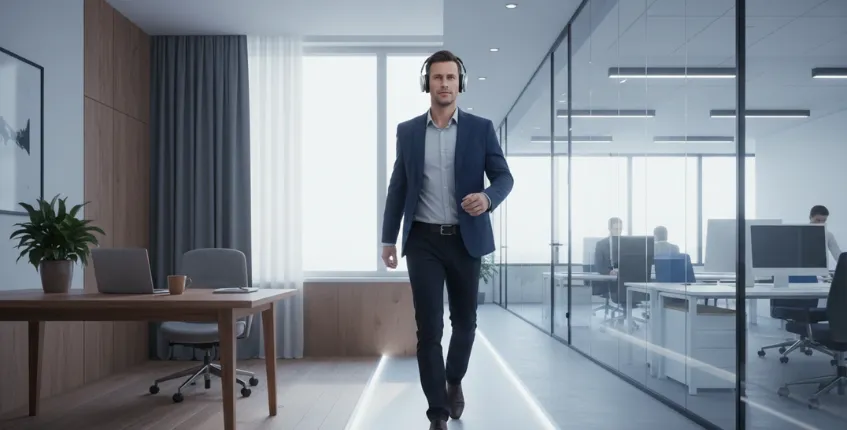
- Tuesday (Office): Open floor plan, fifteen colleagues visible from your desk. Three are on calls simultaneously. The ambient noise level is 68 decibels—equivalent to a busy restaurant. You're presenting to senior leadership via video call. Your headset's 4-mic array isolates your voice from the surrounding conversations. You sound like you're in a private studio.
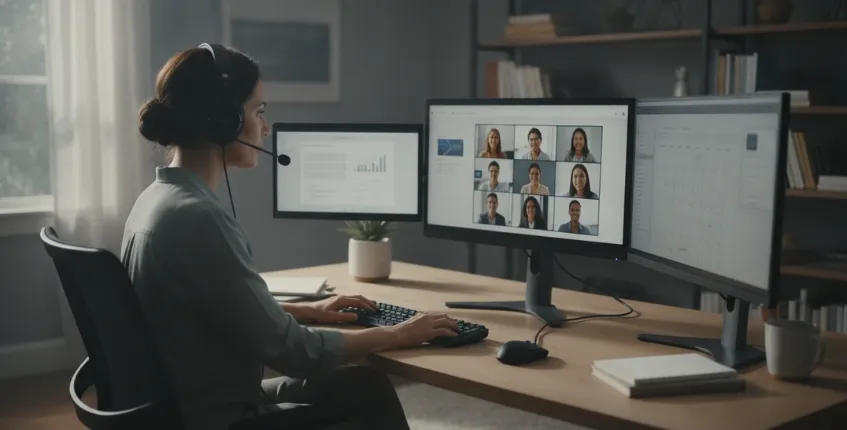
- Wednesday (Home): Quiet day, mostly focused work. One internal team call mid-morning, one client call in the afternoon. The headset stays on for six hours straight—comfort is the primary concern today. Memory foam cushions and balanced weight distribution mean you forget you're wearing it.
- Thursday (Office): All-day meeting marathon. Four hours of back-to-back video calls. You switch seamlessly between your office PC (via USB dongle) and your phone (via Bluetooth) when an urgent call comes in during a meeting break. The multipoint connection handles the transition automatically.
- Friday (Coffee shop): Remote work day. Background music, espresso machine noise, conversations at surrounding tables. Your headset's ENC handles the variable noise while the comfortable design lets you work for hours without fatigue.
This week illustrates why hybrid workers need a headset that spans categories. Any single-environment optimization fails somewhere during the week. The ideal hybrid headset is a Swiss Army knife of audio—versatile enough to handle whatever environment the workweek brings.

The Decision Framework: Choosing a Hybrid Work Headset
- Environmental adaptability: Since your environment changes daily, prioritize noise cancellation that handles diverse noise profiles rather than specializing in one type. AI-powered ENC that adapts to different environments in real time is more valuable for hybrid workers than static noise suppression tuned for a single environment.
- Connectivity flexibility: You'll use different devices in different locations. A headset with USB dongle (for office PC), Bluetooth multipoint (for phone and laptop), and USB-C cable (for backup/charging) covers every scenario without carrying multiple accessories.
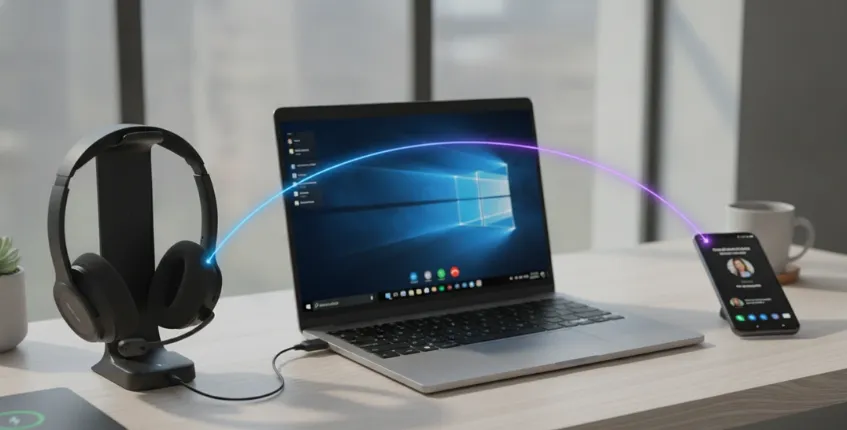
- Portability: If you commute between home and office, your headset travels with you. Look for designs that include a carrying case or travel-friendly folding mechanism. A charging stand at each primary location eliminates the need to transport chargers back and forth.
- IT compatibility: Office IT departments may have restrictions on Bluetooth devices or require specific certifications. USB dongle headsets typically face fewer restrictions than pure Bluetooth devices because they appear as standard USB audio devices rather than paired Bluetooth peripherals.
- Comfort consistency: You'll wear this headset in varied durations across the week. Comfort features that seem excessive for occasional use become essential when cumulative wear time exceeds 20 hours weekly. Memory foam cushions, adjustable tension, and breathable materials aren't luxury features for hybrid workers—they're necessities.
Where the Nearity EP320 Fits for Hybrid Workers
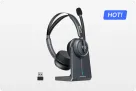
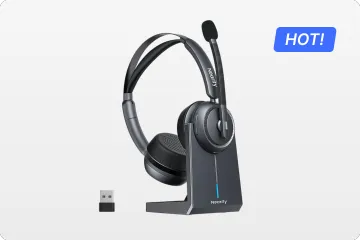
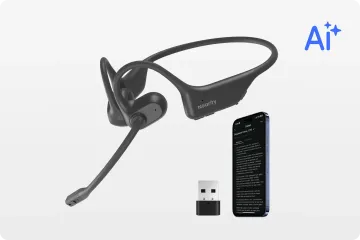
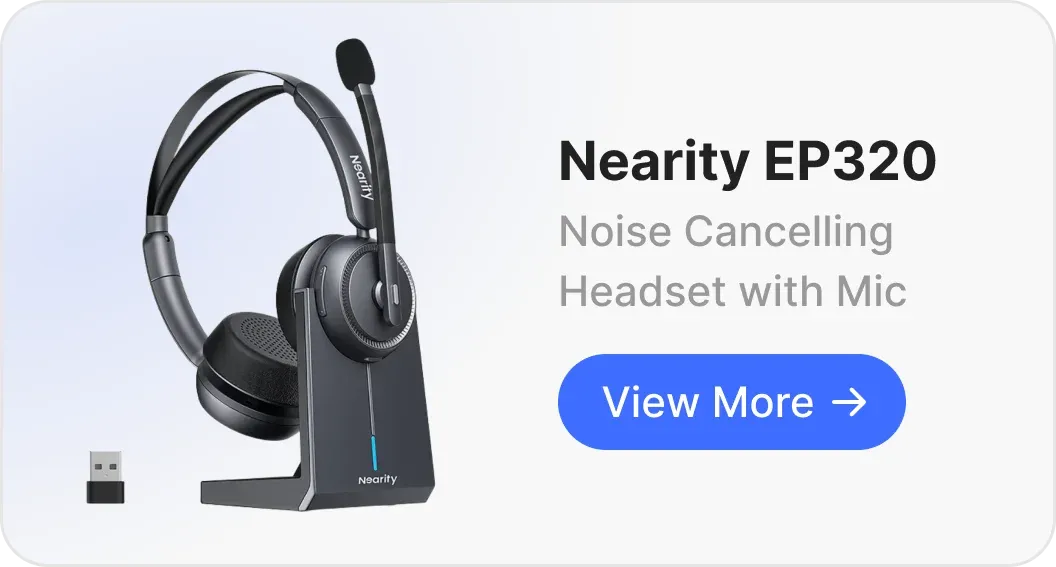
The Nearity EP320 occupies the hybrid-use position that most traditional categories miss. Its 4-mic AI ENC handles both the predictable noise of open offices and the unpredictable noise of home environments. The three connection modes (USB dongle, Bluetooth 5.4 multipoint, USB-C cable) adapt to whatever device setup you encounter at each location. The over ear design with memory foam cushions and adjustable headband maintains comfort across long days regardless of location.
The $127.50 price point reflects practical performance tier positioning—delivering the versatility that hybrid work demands without the enterprise-premium pricing that includes fleet management features individual workers don't need. For the hybrid professional who views their headset as a location-independent work tool, this combination of adaptability and value addresses the gap that traditional "office" and "WFH" categories create.
FAQs
Can I use one headset for both office and home, or do I need two?
One quality headset is almost always the better choice. Using the same headset ensures consistent call quality, comfort, and familiarity regardless of location. You develop an intuitive sense for the mute button placement, audio characteristics, and fit that improves your call performance. Carrying a single headset between locations is simpler than maintaining two sets, and it's more cost-effective. The key is choosing a headset versatile enough for both environments—look for noise cancelling office headset features that also handle home environments, with connectivity options that work with both your office PC and personal devices.
How do I handle headset charging when I work in two locations?
The most reliable approach is a charging stand at each primary location. When you finish work, dock the headset on the stand—it charges automatically and is ready when you return. If you only have one charging stand, keep it at the location where you spend the most time and charge via USB-C cable at the secondary location. Battery life exceeding 30 hours (like the 35-hour talk time on the Nearity EP320) means even without a stand, you can work multiple days between charges.
Will my office IT department approve my personal headset?
Most modern USB and Bluetooth headsets are plug-and-play devices that don't require special drivers or software, making them broadly compatible with corporate systems. USB dongle headsets typically face fewer IT restrictions than Bluetooth devices because they don't require pairing with your PC's Bluetooth stack. However, some enterprises have device approval policies or security restrictions. Check with your IT team before purchasing, and look for headsets that connect via standard USB audio rather than proprietary software.
What's the most important feature for a hybrid work headset?
Microphone noise cancellation (ENC) is the most critical feature because hybrid workers experience the widest variety of acoustic environments. Your callers need consistent voice clarity whether you're in a quiet home office, a noisy open floor plan, or a coffee shop. After ENC, comfort for extended wear is essential because hybrid work often involves long meeting days. Connectivity flexibility (USB + Bluetooth) rounds out the top three because you use different devices in different locations.