Noise Cancelling Headphones with Mic for the Office: Why 99.9% Specs Don't Tell the Full Story
Find the best noise cancelling headphones with mic for office use.
Office Headsets
AI Noise Cancellation
ENC vs ANC
Updated: Aug 19, 2026 · 8 minutes read
Global Business, Brought Near.
No Installer, No Hassle, Just Works.
Not all "noise cancelling" headphones are built for work. While Active Noise Cancellation (ANC) blocks distractions for you, it does little to stop your microphone from picking up office chatter, keyboard clicks, and background noise. This guide explains the critical difference between ANC and ENC, how AI-powered microphone noise cancellation works, and what professionals should look for when choosing a headset for modern offices in 2026.
Key Takeaways
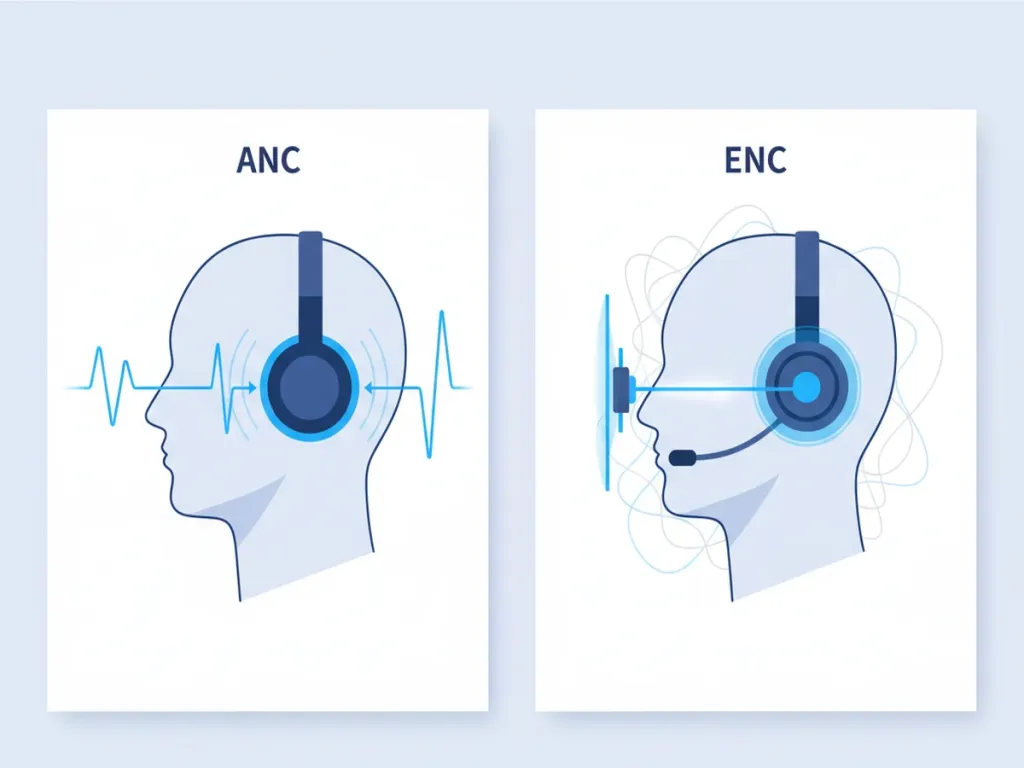
ANC and ENC solve different problems—ANC improves what you hear, while ENC improves what others hear on your calls.
Microphone quality matters more than speaker quality for business communication, making ENC a critical feature for office professionals.
A multi-microphone array, dedicated DSP, and AI-powered algorithms deliver significantly better voice isolation than basic noise reduction methods.
Real-world performance can't be judged by spec sheets alone; practical tests such as keyboard noise, side conversations, and HVAC noise reveal a headset's true capability.
In 2026's hybrid workplaces, choosing a headset that protects both your listening experience and your callers' experience leads to more productive and professional meetings.
Noise Cancelling Headphones with Mic for the Office: Why 99.9% Specs Don't Tell the Full Story
You've been there. Mid-presentation, your colleague three desks away takes a call on speakerphone. The construction crew outside fires up a jackhammer. Your open-plan office's ambient noise level spikes from "coffee shop" to "busy airport terminal." You reach for your noise cancelling headphones, press them tighter against your ears, and hope your microphone isn't transmitting the chaos to your client on the other end of the line.
Here's the frustration: most noise cancelling headphones solve half the problem. They silence the world around you, but they do nothing to silence the world around your microphone. Your caller still hears the keyboard clicks, the side conversations, the air conditioning unit that someone decided should sound like a helicopter. The result is a peculiar asymmetry where you hear perfectly but sound like you're broadcasting from a train station.
This article dissects what noise cancellation actually means in a business context, why the distinction between ANC and ENC determines whether your headset is an asset or a liability, and how to evaluate microphone noise cancellation in ways that spec sheets deliberately obscure.
The Core Mechanism: Why Noise Cancellation Works Differently for Listening vs. Speaking
To understand headset noise cancellation, you need to trace two separate signal paths. The first path carries sound from the world to your ears. The second path carries sound from your mouth to your caller. These paths require fundamentally different technologies, yet most manufacturers conflate them under the single marketing banner of "noise cancelling."
ANC: Protecting Your Ears
Active Noise Cancellation works by capturing ambient sound through external microphones, inverting the waveform, and playing that inverted signal through your headphones. When the original noise and the inverted signal meet at your eardrum, they cancel each other out through destructive interference. This is physics, not software magic, and it's remarkably effective against consistent, low-frequency noise: airplane engines, air conditioning, traffic rumble.
But ANC has limitations. It struggles with sudden, unpredictable sounds—a door slamming, a colleague's laugh, a phone ringing. These transient noises don't have the consistent waveform pattern that ANC can effectively invert. And critically, ANC only affects what you hear. It has zero impact on what your microphone captures and transmits.
ENC: Protecting Your Caller's Ears
Environmental Noise Cancellation works on the microphone signal path. It uses multiple microphone elements—typically positioned around the ear cup and on the microphone boom—to capture both your voice and the ambient environment. Advanced DSP algorithms then compare these signals, identify which sounds originate near your mouth (your voice) and which originate elsewhere (background noise), and suppress the latter.
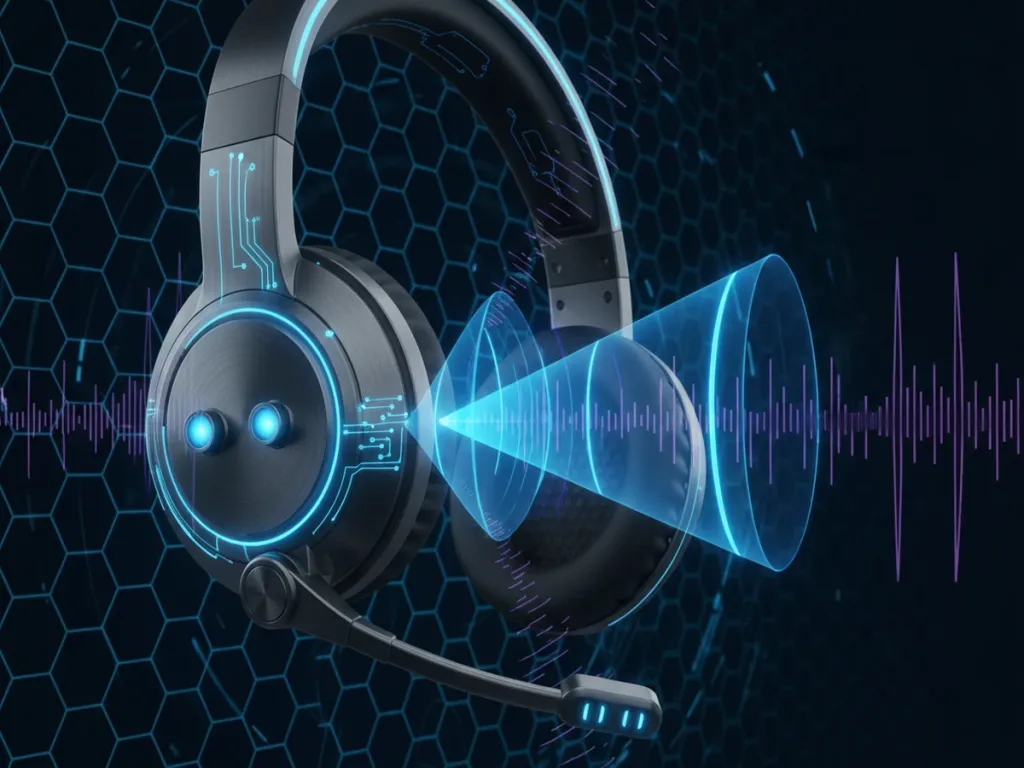
The sophistication of this process determines real-world call quality. Basic ENC uses simple spectral subtraction: identify frequency ranges dominated by noise and reduce their volume. Advanced ENC uses beamforming—treating multiple microphone signals as a phased array to create a directional pickup pattern focused on your mouth. State-of-the-art ENC uses neural networks trained on thousands of hours of audio to distinguish speech from noise with human-like accuracy, even in challenging environments.
Research published in IEEE/ACM Transactions on Audio, Speech, and Language Processingshows that deep learning–based speech enhancement significantly improves speech quality and intelligibility in noisy, reverberant environments compared with conventional signal-processing approaches. This is one reason why AI-powered ENC has become the preferred solution for modern business headsets.
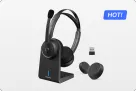
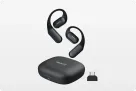
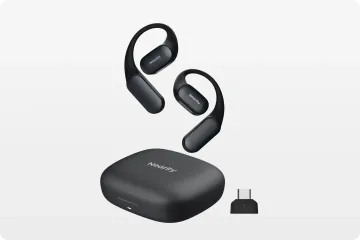
The professional wireless noise cancelling headset, Nearity EP320, employs a 4-mic array with AI-powered ENC processing through a HiFi5 DSP, achieving 99.9% background noise suppression.
Why Chain: Digging into the 'Why' Behind Noise Cancellation Effectiveness
1. Why does the number of microphones matter?
A single microphone captures everything in its environment indiscriminately. Add a second microphone, and you gain spatial information: by comparing when sound reaches each mic, you can estimate direction. With four microphones positioned strategically around the headset, you can create a sophisticated spatial map that distinguishes sounds originating at your mouth (the target) from sounds originating elsewhere (noise to suppress).
More microphones also enable redundancy. In a 4-mic array, if one microphone element is temporarily overwhelmed by a nearby noise source, the other three maintain the spatial reference. This robustness is why professional business headsets consistently outperform consumer headphones with one or two mics, regardless of how advanced the consumer headphone's ANC might be.
2.Why does the DSP processor matter?
Noise cancellation algorithms are computationally intensive. Real-time voice isolation requires analyzing frequency content, spatial patterns, and temporal dynamics simultaneously, then applying suppression filters within milliseconds. A dedicated DSP (Digital Signal Processor) like the HiFi5 handles these calculations efficiently without draining battery or introducing latency.
Consumer headphones typically use general-purpose Bluetooth chips that handle audio transmission, noise cancellation, and voice processing simultaneously. Business headsets with dedicated DSPs offload the noise cancellation computation to specialized hardware, freeing the Bluetooth chip for its primary job and enabling more sophisticated algorithms that would overwhelm general-purpose processors.
3.Why is 99.9% noise suppression possible?
The percentage represents the neural network's ability to identify and suppress non-voice audio content. Modern AI models trained on extensive datasets can distinguish speech from noise across virtually all frequency ranges with remarkable accuracy. The remaining 0.1% typically consists of transient sounds that overlap spectrally with human voice—loud laughter, shouting nearby, or sounds directly adjacent to the microphone.
Devil's Advocate: When Noise Cancelling Headsets Aren't the Right Choice
Despite the benefits, there are legitimate scenarios where a noise cancelling headset with mic isn't the optimal solution.
When situational awareness is critical: Roles that require hearing colleagues, alarms, or ambient cues—office managers, receptionists, security personnel—may find over-ear ENC headsets too isolating. In these cases, open-ear designs or single-ear headsets that leave one ear uncovered may be more appropriate, accepting the trade-off of reduced noise cancellation.
When music quality is the priority: Business headsets optimize for the 100Hz–10kHz vocal range. They don't reproduce the deep bass or sparkling highs that music lovers want. If your work involves 90% music listening and 10% calls, a premium consumer headphone with a good built-in mic may serve you better despite inferior ENC performance.
When budget truly is constrained: Basic wired headsets without ENC can work adequately in quiet environments. If you exclusively work from a private home office with minimal background noise, spending extra for advanced noise cancellation may not deliver proportional value. The key question is whether your environment is consistently quiet or merely usually quiet—because the one day it's not quiet is the day you'll wish you had noise cancellation.
Evaluating Microphone Noise Cancellation: A Practical Framework
Spec sheets list features. They don't tell you how those features perform together in real conditions. Here's a practical evaluation approach:
Test 1: The Keyboard Test Type on a mechanical keyboard while speaking. Your caller should hear your voice clearly with minimal keyboard click intrusion. This tests high-frequency noise suppression—one of the hardest challenges for ENC systems.
Test 2: The Side Conversation Test Have a colleague hold a conversation 6 feet away while you speak. Your caller should hear your voice as the dominant signal. This tests spatial separation and beamforming effectiveness.
Test 3: The HVAC Test Test during active heating or air conditioning cycles. Low-frequency continuous noise is the easiest for ANC but challenging for ENC because it overlaps with the lower frequencies of your voice. Effective ENC maintains vocal clarity without the "underwater" quality that aggressive noise suppression can introduce.
Test 4: The Transition Test Move from a quiet space to a noisy space mid-call. The ENC system should adapt within seconds, not minutes, maintaining consistent voice quality as the environment changes. This tests real-time DSP adaptability.
Key Features to Look for in Noise Cancelling Work Headsets
Beyond the core noise cancellation technology, several features determine daily usability:
Boom microphone design: A boom mic positions the primary microphone element closer to your mouth than ear-cup-mounted mics. This proximity improves the signal-to-noise ratio before any digital processing begins, giving the ENC system cleaner source material to work with. Look for adjustable booms that you can position close to the corner of your mouth without touching it.
Mute button placement: When your dog starts barking or your doorbell rings, you need to mute instantly. A tactile mute button on the microphone boom—where your hand naturally rests during calls—lets you mute without looking or fumbling for controls. Headsets with mute button integration are designed for the reality that interruptions happen.
Comfort for extended wear: Noise cancellation only works when you're actually wearing the headset. If discomfort causes you to remove the headset between calls, you lose the benefit entirely. Memory foam cushions, adjustable headband tension, and breathable materials ensure the headset stays on your head throughout the workday.
Battery life that exceeds your workday: A noise cancelling headset with a dead battery is just an expensive pair of passive headphones. Look for battery life that covers your longest workday with margin to spare—preferably a full week of use on a single charge.
Where the Nearity EP320 Fits in Office Noise Cancellation
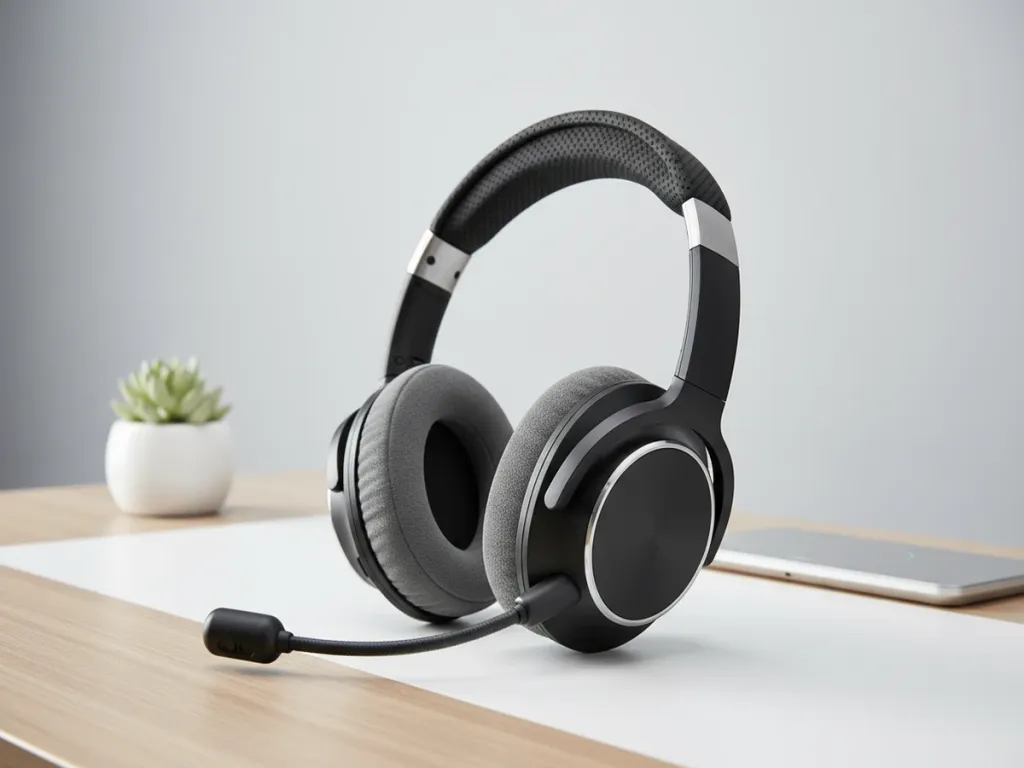
As a noise cancelling headphone with mic for office, the Nearity EP320 approaches office noise cancellation from the microphone-first perspective that professional communication demands.The 4-mic array captures your voice from multiple angles, feeding a HiFi5 DSP that runs AI-powered noise suppression algorithms. The system is specifically trained on office and home environment noise profiles—keyboard clicks, HVAC systems, background conversations, household sounds.
The over ear design adds passive noise isolation that complements the digital ENC, while the adjustable boom mic ensures optimal voice pickup positioning. For the hybrid worker who moves between home office noise (family, pets, deliveries) and corporate office noise (open plans, side conversations, equipment), this dual approach addresses both sides of the noise problem: what you hear and what your caller hears.
FAQs
What's the difference between a noise cancelling headphone with mic for office and a regular Bluetooth headphone?
The fundamental difference is microphone engineering. A best noise cancelling headset for business communication focuses on both listening comfort and microphone performance, rather than ANC alone.Consumer Bluetooth headphones optimize for music listening with microphones designed for casual calls in quiet environments. Business noise cancelling headsets optimize for voice communication with multiple microphone elements, dedicated DSP processing, and algorithms trained specifically to isolate speech from office noise. A consumer headphone might have excellent ANC for your listening but poor microphone noise handling that transmits background sound to your callers. A business headset like the Nearity EP320 invests in both sides of the audio equation.
How does AI noise cancellation compare to traditional ENC methods?
Traditional ENC uses rule-based algorithms—spectral subtraction, adaptive filtering, basic beamforming—to reduce noise. AI-powered ENC uses neural networks trained on thousands of hours of audio to recognize patterns that distinguish speech from noise. The AI approach handles edge cases better: a baby's cry, a dog bark, keyboard clicks with unusual timing. Traditional methods work well for consistent noise (HVAC, traffic) but struggle with unpredictable sounds. AI-based systems adapt in real time to novel noise sources they weren't explicitly programmed to handle. The trade-off is that AI ENC requires dedicated DSP hardware, which increases cost but delivers measurably better suppression across diverse noise environments.
Can I use noise cancelling work headsets for music and entertainment?
Yes, but with realistic expectations. Business headsets are tuned for the vocal frequency range (approximately 100Hz–10kHz) where human speech lives. They reproduce music adequately but won't deliver the deep bass extension, soundstage width, or high-frequency sparkle of headphones designed for music. If music quality is important to you, consider a dual-headset approach: a business headset for calls and a music headphone for listening. Alternatively, some modern business headsets offer "music modes" that adjust the EQ for broader frequency response at the cost of some vocal clarity.
Do all noise cancelling headsets work with Zoom, Teams, and other platforms?
Most modern USB and Bluetooth headsets work with all major conferencing platforms without special drivers or software. The headset appears as a standard audio device to your computer, and the noise cancellation processing happens internally within the headset itself—not on your computer. This means the ENC quality is consistent regardless of which platform you're using. However, headsets certified for specific platforms (like "Certified for Microsoft Teams") have been tested and verified for compatibility, which may matter in enterprise IT environments with strict device policies.
Ready for crystal-clear calls in any environment? Explore the Nearity EP320 with 4-mic AI-powered ENC and 99.9% noise suppression for professional office communication.