Safe Headphones at Home: How Soundstage Prevents Volume Creep
Volume creep — the subconscious habit of nudging headphone volume upward as your ears tire — quietly accelerates noise-induced hearing loss.
safe headphones
what is soundstage
hearing damage from headphones
Updated: Sep 23, 2026 · 5 minutes read
Global Business, Brought Near.
No Installer, No Hassle, Just Works.
Most at-home listeners slowly turn their headphones louder as auditory fatigue sets in, pushing exposure past the 85 dB safety line without noticing. Headphones with a wide soundstage separate instruments spatially, so detail stays clear at conservative volumes — making acoustic design itself a hearing-safety feature.
Key Takeaways
Volume creep is measurable: as auditory fatigue builds over a session, listeners typically nudge volume up 5-10 dB without realizing it, halving safe exposure time with every 3 dB.
The 85 dB / 8-hour threshold (NIOSH) is the reference line for safe listening; every 3 dB above it cuts safe exposure time in half.
A wide soundstage fights masking — when instruments are spatially separated, you hear detail at 65-70 dB that congested tuning only reveals at 85+ dB.
Open-back over-ears are generally the safest architecture at home; IEMs carry the highest risk because their seal tempts bass-heavy, high-volume tuning.
The 60/60 rule (60% volume, 60 minutes max before a break) plus device volume limiters catches most risky listening before damage accumulates.
If you wear headphones four to eight hours a day at home, you've probably noticed the pattern: everything sounds fine in the morning, but by evening your ears ache, feel strangely full, or ring faintly when you finally take the cups off.
Choosing safe headphones matters more than most people realize, because the biggest threat to your hearing isn't one loud moment. It's a slow, invisible habit called volume creep — and the acoustics of your headphones either fight it or feed it.
Understanding "Volume Creep" and Hearing Damage
Volume creep is the subconscious tendency to nudge the volume upward as a listening session goes on.
It happens because of auditory fatigue: after extended exposure, the hair cells and synapses in your cochlea temporarily lose sensitivity, so the same volume starts sounding quieter than it did an hour ago.
The core mechanism of hearing damage from headphones: not explosive volume, but chronic overexposure. The damaged hair cells don't regenerate.
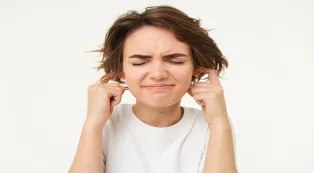
The first warning signs — dull aches, a clogged feeling, temporary ringing (tinnitus) after long sessions — are your ears reporting that the dose is already too high.
Why Does Spatial Separation Matter for Your Ears?
Ask an audiophile "what is soundstage?" and they'll describe the perceived physical space of a recording: how wide the stereo image stretches, how deep the front-to-back layering feels, and how precisely each instrument sits in its own position — the imaging.
On headphones with a wide soundstage, a jazz trio sounds like three musicians spread across a room.
On headphones with a narrow soundstage, the same recording collapses into a congested blob inside your head.
This matters for safety because of masking.
When instruments overlap in a congested mix, they hide each other's details. Your brain, wanting to resolve the vocals or catch the dialogue in a game, asks for more energy — so you turn the volume up.
You're not chasing loudness; you're chasing clarity. But your cochlea can't tell the difference, and the damage accumulates just the same.
How a Wide Soundstage Stops Volume Creep Before It Starts
A wide, well-imaged soundstage breaks the masking problem mechanically.
When instruments are spatially separated, each one occupies its own "lane" in the stereo field, so details remain audible at conservative levels.
That has a compounding benefit across a long day:
Because you start lower, auditory fatigue sets in more slowly.
Because fatigue is milder, the urge to nudge the volume never builds.
The feedback loop that drives volume creep — fatigue, louder, more fatigue, louder still — never closes.
What Makes Safe Headphones?
There's no regulatory "safe headphone" certification, but you can evaluate any model against five criteria:
Clarity at low volume
The single most important trait. Audition at a deliberately low level: if vocals and dialogue stay intelligible, the tuning works with your ears, not against them.
Low distortion at moderate levels
Distortion reads as "harshness" and accelerates listening fatigue, which feeds volume creep.
Comfort for long sessions
Heavy clamping and sealed, sweaty pads cause physical fatigue that listeners often mismanage by getting louder or wearing the set longer than they should.
Isolation appropriate to your room
In a noisy space, ANC closed-backs protect you by lowering the volume you need.
In a quiet home, open-back designs are the safer choice.
Open-Back vs. Closed-Back vs. IEMs: Which Architecture Protects Your Hearing Best?
Factor
Open-back over-ear
Closed-back over-ear
IEMs (in-ear)
Soundstage width
Widest, most natural
Moderate
Narrowest
Clarity at low volume
Excellent
Good
Often bass-masked
Ambient noise isolation
None
Good (great with ANC)
Strong passive seal
Temptation to over-volume
Low in quiet rooms
Moderate
High — seal encourages bass boost
Best environment
Quiet home
Noisy rooms, travel
Commutes, exercise
Overall safety verdict
Safest at home
Safest in noise
Highest risk for long sessions
The pattern: match the architecture to the noise floor.
In silence, open-back wins on every safety metric — spacious sound, no occlusion pressure, no isolation-driven volume compensation.
In noise, closed-back ANC wins, because isolation is what keeps your volume low.
Practical Tips to Maintain Healthy At-Home Listening Habits
Hardware helps, but habits finish the job:
Follow the 60/60 rule
Stay at or below 60% of maximum device volume, and take a 5–10 minute break every 60 minutes. Breaks let temporary threshold shift recover instead of accumulating.
Use ANC in noise instead of volume
If household noise intrudes, isolation beats amplification every time.
Re-baseline every morning
Start each session by turning the volume down until content is just barely comfortable, rather than resuming yesterday's level.
Keep voice calls natural
If meetings dominate your day, a headset with an open acoustic design and a quality mic — the way a good headset with noise cancelling mic handles voice — keeps call volume low without losing speech clarity.
FAQs
1.What is a safe headphone volume for daily listening?
Keep average levels under 85 dB — roughly 50–60% of maximum device volume on most phones.
The WHO and NIOSH treat 85 dB over eight hours as the daily safe limit, with safe time halving for every 3 dB increase. The 60/60 rule (60% volume, a break every 60 minutes) is a practical proxy.
2.What is soundstage in headphones, in simple terms?
Soundstage is the perceived physical space of the music — how wide, deep, and precisely positioned instruments sound, as if the band were arranged in a room around you rather than inside your skull.
Wide soundstage comes from driver design and open acoustics, not from turning the volume up.
3.Are open-back headphones safer for your hearing?
In quiet environments, generally yes.
Their wide soundstage resolves detail at lower volumes, and the open design eliminates the sealed-chamber pressure that encourages bass boosting. In noisy places the advantage reverses — outside noise leaks in and tempts you to crank the volume, where ANC closed-backs are safer.
4.Does noise cancelling protect your hearing?
Indirectly, yes.
By removing competing background noise, ANC lets you hear content clearly at lower volumes instead of drowning out the room. The protection comes entirely from the lower listening level it enables — ANC itself adds no hearing benefit if you keep the volume high.