Why Do My Ears Hurt When I Wear Headphones? Heat, Sweat, and the Fix
Your ears hurt, feel hot, and get sweaty on long calls because sealed ear cups trap heat and trigger the occlusion effect.
why do my ears hurt when i wear headphones
sweat and headphones
comfortable on ear headphones
Updated: Sep 23, 2026 · 5 minutes read
Global Business, Brought Near.
No Installer, No Hassle, Just Works.
Sealed and ANC headphones trap heat and block your ear canal, causing sweat, pressure, and a booming 'underwater' voice — the occlusion effect. Open-back communication headsets vent heat and restore natural self-monitoring, making them the most comfortable fix for all-day video meetings.
Key Takeaways
The occlusion effect can make your own voice sound up to 20 dB louder inside a sealed ear canal, which is why you instinctively shout or mumble on calls.
Ear-cup heat isn't imagination: a closed ear cup can raise skin temperature around the ear within 30-60 minutes of wear, and sweat follows.
Open-back headsets trade ambient-noise isolation for natural vocal feedback — the right trade for quiet home offices, the wrong one for noisy open floors.
If you must keep a closed design, velour pads, lower clamping force, and 5-minute hourly breaks reduce heat and pressure measurably.
If you've ever finished a day of back-to-back Zoom calls, peeled off your headset, and typed "why do my ears hurt when I wear headphones" into a search bar, you're in good company.
Remote and hybrid professionals report the same cluster of complaints: Ears that feel hot and sweaty, a strange pressure or "clogged" sensation, and a voice that booms inside their own head every time they speak. None of this is imaginary.
It's physics and biology — and once you understand the mechanism, the fix becomes obvious.
The Hidden Cause of "Meeting Voice Anxiety": Why You Hate Speaking on Video Calls
You unmute on Teams, start talking, and something feels wrong. Your voice sounds muffled and enormous at the same time, like you're speaking underwater. You can't judge your own volume, so you either shout over colleagues or trail off into a mumble. After an hour, you're subtly dreading your next turn to speak.
That hesitation has a name in the hearing world: disrupted self-monitoring. Humans regulate speech volume and tone by hearing ourselves in real time, through a mix of air-conducted sound (your voice traveling through the air to your ears) and bone-conducted sound (vibrations traveling through your skull). When a sealed headphone cup blocks the air-conducted path, that feedback loop breaks.
The result is the "meeting voice anxiety" so many professionals describe — a constant, low-grade uncertainty about how you sound to others, layered on top of the physical discomfort of hot, sore ears.
The discomfort and the anxiety share one root cause.
What Is the Occlusion Effect? (Why Your Ears Feel Clogged When Talking)
The occlusion effect is what happens when your ear canal is sealed — by an earplug, an in-ear bud, or a tightly closed headphone cup — while you're producing sound.
Normally, the low-frequency vibrations of your own voice escape through the open ear canal. Block that exit, and the bone-conducted energy bounces back toward your eardrum instead. This is why your voice suddenly sounds boomy and "inside your head."
This is the same phenomenon that makes your voice sound strange when you talk with your fingers in your ears. Active noise canceling (ANC) makes it worse: by erasing ambient room sound, ANC removes the environmental reference points your brain uses to calibrate loudness, so the internal booming feels even more dominant.
Now add heat. A closed ear cup is, by design, a sealed chamber. Your pinna (outer ear) and the skin around it radiate heat constantly, and a leatherette pad pressed against that skin traps both the heat and the moisture. Within 30 to 60 minutes of wear, the microclimate inside the cup gets measurably warmer and more humid. So when people search for cooling headphones, what they're really asking for is ventilation — and no sealed cup, however fancy its gel pads, can truly provide it.
Open vs. Closed-Back Headphones: Acoustic Physics Explained for Remote Workers
The difference between the two designs is simpler than marketing makes it sound:
Closed-back headphones seal the rear of the driver. Air can't move through the cup, so sound stays in and outside noise stays out. Great for focus in a loud room — but the same seal traps heat, sweat, and your own voice.
Open-back headphones perforate or grille the rear of the cup. Air flows freely, heat escapes continuously, and — critically — your own voice reaches your ears naturally, the way it does when you speak with nothing on your head at all.
Factor
Closed-back / ANC
Open-back
Your own voice on calls
Boomy, occluded, "underwater"
Natural, like speaking bareheaded
Heat and sweat over 4+ hours
Builds up steadily
Vents continuously
Ambient noise isolation
Strong (passive + ANC)
Minimal
Sound leakage to others
Very low
Low at meeting volumes
Volume self-monitoring
Impaired
Fully natural
Best environment
Noisy open-plan office, travel
Home office, private room
Notice the honest trade-off: open-back designs give you vocal naturalness and thermal comfort, but they do not isolate you from a noisy environment.
Why an Open-Back Headset Restores Natural Speech and Eliminates Call Fatigue
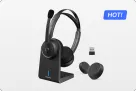
For voice-first work, an open-back communication headset attacks every symptom at once. Because the ear canal is never sealed, the occlusion effect simply doesn't occur — your voice sounds like your voice, so you stop over-correcting your volume.
The comfort gains are just as direct. Continuous airflow makes open-back models the closest thing to genuinely cooling headphones on the market — heat and moisture never accumulate in the first place. Combined with lighter clamping force and breathable fabric pads, they rank among the most comfortable on ear headphones for eight-hour wear, and the end-of-day soreness that sent you searching simply disappears.
Professionals often worry this means sacrificing microphone quality. It doesn't. Voice pickup is the boom mic's job, not the ear cup's: a well-designed headset with noise cancelling mic isolates your voice from keyboard clatter and household sounds regardless of whether the cups are open or closed.
Key Considerations Before Buying an Open-Back Headset
Open-back is the right answer for most remote professionals — but not all. Run through this checklist first:
Assess your noise floor
If your environment is a quiet home office or private room, open-back is ideal.
If you share space with kids, roommates, or a loud open-plan floor, you may want a noise cancelling headphone for work for deep-focus hours and an open-back headset for meetings.
Check weight and clamping force
Under 200 grams with a self-adjusting headband is the sweet spot for all-day wear. Even breathable headphones hurt if they grip too hard.
For high-volume call environments, such as support or sales teams, look at a noise cancelling headphone for call center use — these pair open or semi-open acoustics with broadcast-grade boom mics and all-day durability ratings.
The pattern to remember: choose closed-back for listening in noisy places, open-back for speaking all day in quiet ones.
FAQs
1.Q: Why do my ears hurt when I wear headphones all day?
A: Usually it's a combination of clamping pressure on the outer ear, heat and sweat trapped by sealed ear pads, and the occlusion effect — your own voice resonating in a blocked ear canal.
Loosening the fit, switching to breathable pads, or moving to an open-back headset resolves most cases.
2.Q: Do open-back headphones leak sound into my microphone?
A: At normal meeting volumes, leakage is minimal and a decent boom microphone won't pick it up. Problems only appear at loud music-listening levels.
For voice-first use, a quality open-back headset with a noise-cancelling boom mic keeps outgoing audio clean.
3.Q: Can I use an open-back headset in a shared office?
A: It depends on your floor.
Open-back cups leak a little sound and let office noise in, so they suit quiet home offices and private rooms best. In a loud open-plan space, pair them with a noise-cancelling boom mic for your voice, or keep a closed-back pair for focus time.