Beyond the App: Why Your Hybrid Work Software Needs a Physical Anchor for Peak Performance
This definitive guide explores how organizations can bridge the gap between remote software and physical office reality by using interactive hardware anchors to achieve peak hybrid team performance.
Smart Whiteboard
Digital Transformation
Remote Work
Updated: Aug 19, 2026 · 10 minutes read
Global Business, Brought Near.
No Installer, No Hassle, Just Works.
In the professional landscape of 2026, organizations are moving beyond the "software-only" experiment, discovering that digital tools alone cannot sustain long-term innovation. This Ultimate Guide addresses the systemic crisis of Digital Exhaustion and Cognitive Friction caused by the minimalist laptop-centric model. By exploring the critical need for a "Physical Anchor"—specifically the Windows-powered NearHub S Max Smart Whiteboard—the article provides a blueprint for Intentional Presence. The guide examines five essential pillars of integrated infrastructure: AI-driven presence equity, zero-latency interaction, acoustic inclusion, seamless room management, and secure documentation. Ultimately, it demonstrates how a hardware-software synergy allows leaders to strengthen hybrid work security and implement comprehensive wellness programs, turning the office into a high-performance "Innovation Theater" that attracts top talent and maximizes real estate ROI.
Key Takeaways
Bridge the Phygital Gap: Software needs a physical anchor in the office to ground collaboration and prevent the "Spectator Effect" among remote workers.
Eliminate the "Setup Tax": Use standalone interactive hubs with native Windows integration and calendar sync to launch meetings in under 60 seconds, reclaiming lost productivity.
Prioritize Presence Equity: Leverage AI Speaker Tracking and Gallery View to ensure every member of the hybrid team has the same visual weight and interactive influence.
Enhance Cognitive Ergonomics: Improve hybrid worker wellness by shifting from sedentary, small-screen work to active, standing collaboration at large-scale 4K displays.
Secure the Distributed Perimeter: Strengthen hybrid work security by utilizing hardware that integrates natively with existing Active Directory and enterprise management protocols.
Adopt Digital-First Documentation: Ensure all brainstorms are instantly digitized and cloud-synced, preventing "Documentation Decay" and maintaining a single source of truth.
Optimize ROI Through Rightsizing: Reduce total office square footage while increasing the quality of collaborative spaces through high-performance "Innovation Theaters."
Shift to Impact Management: Move away from monitoring attendance to measuring "Innovation Velocity" and the speed at which ideas move from sketch to execution.
We have all been there: it is 2:00 PM on a Wednesday, and you are currently toggling between seventeen different browser tabs. You have Slack open for "quick" pings, Jira for task tracking, Zoom for the meeting you are currently in, and Miro for the brainstorm that no one is actually interacting with. Despite having an expensive software stack, your team feels more fragmented than ever. You are suffering from Digital Exhaustion—the feeling that you are shouting into a vacuum. In 2026, the problem isn't a lack of apps; it is that your digital workspace lacks a physical anchor. High-performance hybrid work tools are the missing link that transforms a ghost-town office into an innovation theater.
Welcome to this comprehensive Ultimate Guide, a definitive pillar page designed to solve the systemic disconnect between remote flexibility and office execution. In this guide, we explore why successful organizations have realized that hybrid work tools serve as the connective tissue merging digital workflows with physical presence. Within the first 100 words, it is critical to recognize that these tools are the foundation for peak performance in a distributed environment. Whether you are a Chief Technology Officer or a team lead, this roadmap provides the strategic framework required to synchronize your workforce effectively.
The Software Illusion: Why Distributed Teams Are Stalling in 2026
In the early 2020s, the corporate world made a massive bet: that software could replace the office entirely. We flooded our teams with collaboration suites and assumed a webcam was enough to sustain innovation. By 2026, the results of this experiment are clear: software alone cannot sustain long-term creative friction.
The Rise of Cognitive Friction
When your entire professional existence is confined to a 13-inch laptop screen, your brain works twice as hard to maintain context. This cognitive friction leads to a 40% drop in productivity during context switching. Remote workers often suffer from the Spectator Effect—joining meetings but feeling like observers rather than participants. Furthermore, Documentation Decay occurs when ideas shared in quick huddles are lost because they weren't anchored to a persistent digital-physical canvas.
According to a 2026 report by Gartner, organizations relying solely on hybrid work software for collaboration see a 30% higher burnout rate than those utilizing integrated hubs. The missing link is the hardware that brings these apps into the physical world, allowing for a natural flow of ideas.
Defining the Physical Anchor: What are Hybrid Work Tools?
To move beyond the software illusion, we must redefine our understanding of hybrid work tools. In the modern market, these tools are the foundation of Intentional Presence. They are not merely accessories; they are the environment in which high-stakes collaboration happens.
The Core Characteristics of High-Performance Tools
For a piece of hardware to be classified among effective hybrid work tools, it must meet three specific criteria:
Technological Symmetry: It must offer an experience in the office that is vastly superior to what an employee has in their home setup.
Presence Equity: It must ensure that a person on the screen has the same visual weight and interactive influence as a person in the room.
Workflow Persistence: It must ensure that digital notes do not disappear when the meeting ends, allowing for asynchronous follow-ups.
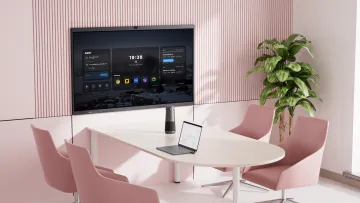
If you ask an employee to commute just to sit in a cubicle and use the same software they have at home, they will naturally resist. However, if the office provides a NearHub Board Max—a tool allowing for life-sized video and zero-latency sketching—the commute yields a collaborative surplus. This is how you turn your office from a mandate into a magnet for top talent.
Beyond the Browser: How Hybrid Work Software Meets Physical Reality
The greatest innovation of 2026 is the Phygital bridge—the place where your hybrid work software is no longer trapped behind a browser tab but is projected into a physical interactive space.
Native Integration vs. Mirrored Displays
Many legacy offices use dumb TVs that simply mirror a laptop screen. This is a strategic mistake that limits functionality.
Native App Support: A professional smart white board runs the full desktop versions of Microsoft 365, Teams, and Zoom natively.
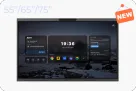
Windows 11 Pro Power: Because the NearHub Board Max runs on a Windows-based architecture, you have 100% feature parity. You are not using a limited mobile version of your favorite tools; you are using the real thing on an 86-inch 4K canvas.
The One-Touch Join Protocol
Nothing kills innovation faster than technical debt—the 15 minutes fumbled at the start of every meeting trying to find a cable. By syncing your room calendar with your interactive hub, you walk into the room and tap a single button. Your hybrid work tools are live, your remote colleagues are life-sized, and your digital canvas is ready for input in under 60 seconds.
The 5 Critical Pillars of Integrated Hybrid Work Tools
Building a high-performance team requires an audit of your infrastructure. Here are the five pillars that define the most effective hybrid work tools in 2026.
1. Presence Equity via AI Vision
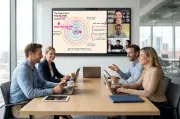
Remote workers must not be second-class citizens. Advanced hardware utilizes Speaker Tracking to automatically zoom in on the person talking, capturing essential non-verbal cues. Additionally, AI Gallery View takes everyone in the physical room and places them in individual digital tiles, leveling the playing field for those joining remotely.
2. Zero-Latency Interactive Canvases
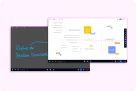
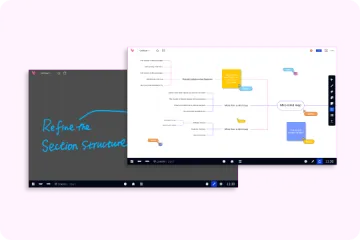
Visual logic is the language of innovation. If there is a delay between the stylus and the screen, the flow state is broken. Professional PenTouch technology allows for sketching that feels as natural as paper, with every mark saved instantly to the cloud for persistent access.
3. Integrated Audio Arrays
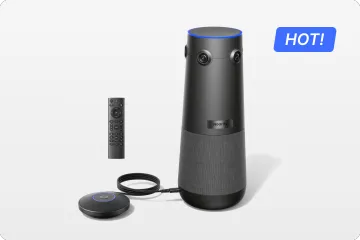
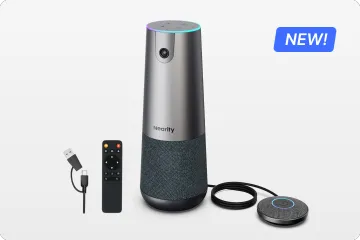
If the remote team cannot hear the side-chatter, they lose 50% of the meeting context. High-performance hybrid work tools use beamforming microphones to isolate voices and suppress background noise, ensuring the remote voice sounds rich and physically present in the room.
4. Room Management and Calendar Sync
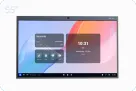
Eliminating room poaching is a core part of effective hybrid workplace solutions. Interactive boards should act as status indicators, showing if a room is booked. Native integration allows the board to know which meeting is happening and open the relevant files automatically as the team enters.
5. Seamless Documentation Export
Documentation is where many distributed teams fail. A professional smart white board allows for one-click PDF exports to all participants or QR code sharing, letting people take the meeting notes with them on their mobile devices as they leave.
Security in a Phygital World: Strengthening Hybrid Work Security
As you move data from personal laptops to shared interactive boards, hybrid work security becomes a top priority. You cannot have sensitive strategic roadmaps left on an unsecured device in a shared conference room.
The IT Foundation of a Secure Office
A professional toolkit must integrate with your existing security protocols.
Active Directory Integration: Ensure that only authorized users can log into the nearhub board.
Auto-Wipe Features: The board should clear local cache data between sessions to prevent unauthorized access to confidential information.
Encrypted Cloud Sync: All annotations should be sent via encrypted channels to your corporate storage, such as OneDrive or Google Drive.
Managing the Attack Surface
With more devices connected to your network, you need a centralized management system. Remote Management (MDM) allows your IT department to push security updates to all smart boards globally from a single dashboard. For high-security zones, multi-factor authentication or PIN access should be required to unlock the interactive canvas.
Ergonomics and Mindset: Building a Hybrid Worker Wellness Program
Wellness is often the forgotten component of infrastructure. However, a successful hybrid worker wellness program is built on the physical comfort and mental clarity of your staff.
Combating Screen Fatigue
Staring at a small laptop for eight hours is biologically draining. Moving to a large-scale smart white board allows the eyes to shift focus distance, reducing strain. Furthermore, interactive boards encourage people to stand up and walk around, which increases oxygen flow to the brain and boosts creativity.
Psychological Inclusion
Isolation is a primary driver of burnout. When a remote worker's sketch appears in 4K in the physical office, they feel a sense of spatial presence. Eliminating technical friction through automation reduces the background anxiety that leads to long-term fatigue, making it a vital part of your hybrid worker wellness program.
Shifting to Intentionality: Strategic Implementation of Hybrid Work Tools
Choosing the right hybrid work tools is only half the battle. You must also master the strategy of how to use them to drive ROI. This requires a shift from managing attendance to managing impact.
Step-by-Step: Turning Design into Performance
Audit Cultural Friction: Ask your team where they feel the biggest disconnect between home and office workflows.
Implement Activity-Based Presence: Define which tasks, such as strategy sprints or mentorship, require the physical anchor of the office.
Master Your Hardware: Provide training on how to use a smart board so that every leader can start a session in under 60 seconds.
Measure Innovation Velocity: Track how quickly ideas move from the digital canvas to project execution.
The ROI of the Physical Anchor
Investing in a NearHub Board Max pays for itself through real estate efficiency—you need less square footage if every room is a high-performance innovation theater. Additionally, talent retention improves because top-tier employees will not stay in an organization that forces them to use outdated, frustrating technology.
FAQ Section: Optimizing Your Phygital Toolkit
How do I use a smart board to bridge the remote gap?
A smart white board creates a shared digital reality. When you sketch in the office, the remote participant sees it in real-time. They can also grab a virtual pen from their laptop and draw on the same board, making them an equal participant in the creative process.
What are the most essential hybrid work tools for a startup?
Start with the Big Three: A high-quality interactive hub like nearhub, a robust cloud-based project management app, and an asynchronous video tool. One piece of high-quality hardware is often more productive than ten minor software subscriptions.
Is hybrid work security different from traditional office security?
Yes. It involves securing a distributed network and ensuring that data shared in phygital spaces is encrypted and cleared between sessions. Using Windows-based hardware allows your IT team to use their existing enterprise security tools effectively.
How does an interactive board support a hybrid worker wellness program?
It reduces eye strain by providing a larger focal point and encourages movement during meetings. It also fosters psychological safety by ensuring remote workers feel physically represented and valued during team discussions.
Can I run my existing hybrid work software on the NearHub Board Max?
Absolutely. Because it runs on Windows 11 Pro, it supports the full desktop versions of over 1,000 apps, including Microsoft 365, Google Workspace, Zoom, Teams, Slack, and Miro.
Conclusion & CTA
The transition to a hybrid-first world is the most significant shift in corporate culture in over a century. Successfully navigating this change requires a radical commitment to providing the right hybrid work tools for your team. By defining the office as a specialized destination for collaboration and equipping it with high-performance hardware, you turn your strategy into a competitive advantage.
A high-performance toolkit is built on a foundation of trust, equity, and the right infrastructure. When you eliminate the tiny-screen struggle and replace it with professional-grade tools like the NearHub Board Max, you are investing in the long-term innovation and health of your team. The goal is simple: to make the work as rewarding as the result. Don't let your office reality lag behind your digital strategy.