Why Do Some Headsets Sound Great for Music but Bad for Calls?
Your headphones can deliver rich, detailed music and still make you sound muffled on calls.
headset with best microphone quality
best headphones for music and phone calls
best headset for business calls
Updated: Sep 18, 2026 · 5 minutes read
Global Business, Brought Near.
No Installer, No Hassle, Just Works.
Music playback depends on drivers and tuning; call quality depends on the microphone, noise suppression, and voice bandwidth — which is why great-sounding headphones often perform badly on calls.
A boom mic, a multi-mic array, and AI-powered ENC matter far more for clear calls than speaker size or volume.
Key Takeaways
Music quality and call quality are separate systems: drivers determine what you hear, while the microphone and DSP determine what others hear.
A boom mic placed 1–2 cm from the corner of your mouth captures a cleaner voice signal than any in-earcup microphone can.
Turning up the volume does not improve speech clarity — intelligibility depends on frequency response and signal-to-noise ratio, not loudness.
ANC quiets what you hear; ENC quiets what your callers hear. For business calls, ENC is the feature that matters.
Look for 3–4 microphones, AI noise suppression, wideband voice, and 35+ hours of talk time when choosing a headset for calls.
You put on your favorite headphones, press play, and the music sounds rich and immersive. Then you join a Zoom meeting — and a colleague says you sound like you are calling from inside a tunnel.
Your headphones are not broken. Music playback and voice calls are two completely different engineering challenges, and most consumer headphones are only built to solve one of them.
This guide explains what really determines call clarity and gives you a practical framework for choosing a headset that performs well in both directions.
What Determines Voice Clarity on a Headset?
A headset does two jobs: it plays sound to you, and it captures sound from you. Different hardware handles each job.
What you hear depends on the speaker drivers, acoustic tuning, and the playback codec.
What others hear depends on the microphone elements, their placement, the digital signal processor (DSP), and the voice transmission bandwidth.
Bandwidth makes the gap worse. Traditional phone calls compress speech into a narrow band of roughly 300 Hz to 3.4 kHz, stripping out the warmth and detail of your voice. Wideband "HD voice" roughly doubles that range — but only if the microphone can deliver a clean, full-range signal in the first place.
This also explains a common frustration: people asking why do my headphones sound low quality the moment a call starts.
How Microphone Quality Affects Call and Speech Clarity?
The microphone is the single biggest factor in how you sound to others, and three things define it:
1. Proximity.
A microphone close to your mouth captures a strong voice signal relative to everything else in the room.
A boom mic sitting 1–2 cm from the corner of your mouth starts with a huge physical advantage over tiny mics buried in an earcup or earbud—before any digital processing even begins.
2. Pickup pattern.
Omnidirectional microphones capture sound equally from all directions, including your keyboard and air conditioner.
Directional and beamforming designs focus on your mouth and reject off-axis noise, using the timing differences between multiple mic elements to electronically "aim" at your voice.
3. Processing.
A dedicated DSP can identify human speech, suppress steady background noise, tame plosives ("P" and "B" bursts), and keep your volume consistent as you move your head.
Positioning matters too: even an excellent boom mic underperforms behind your cheek or in front of your nose, where breath noise hits it. Aim for the corner of your mouth, roughly a finger's width away.
Why Background Noise Can Make Your Voice Sound Worse?
Your microphone cannot tell the difference between your voice and the dog barking behind you — it captures everything, and your voice competes with all of it.
This is a signal-to-noise ratio problem: as background noise rises, your voice becomes harder to isolate, and listeners rate the call as "bad quality" even if the microphone itself is decent.
Noise also triggers ugly side effects in cheap headsets.
Automatic gain control pumps the volume up whenever you stop talking, amplifying the room.
Aggressive noise gates chop off the beginnings and ends of words.
Crude suppression algorithms smear your speech along with the noise, producing that underwater, robotic sound everyone recognizes from bad conference calls.
The typical culprits: mechanical keyboards, HVAC systems, open-plan chatter, traffic, and pets. A headset that handles them well does so through a combination of physical pickup design and intelligent processing — not one magic feature.
What Makes a Headset With the Best Microphone Quality?
When comparing options, evaluate these features in order of impact:
Feature
What to look for
Why it matters
Microphone design
Boom mic + 3–4 mic array
Proximity and beamforming isolate your voice
Noise suppression
AI-powered ENC with a dedicated DSP
Removes keyboard, fan, and household noise in real time
Voice bandwidth
Wideband / HD voice support
Preserves the natural detail of your speech
Connectivity
Bluetooth 5.4+ with multipoint, plus a USB dongle
A dongle bypasses the Bluetooth bandwidth drop on calls
Final Thoughts on Choosing a Headset for Clear Voice Communication
A headset that thrills you with music can still fail you in meetings, because playback quality and microphone quality are separate systems.
The fix is not more volume; it is better capture: a boom mic near your mouth, a multi-mic array, AI-powered ENC, wideband voice, and a connection that does not strangle your bandwidth.
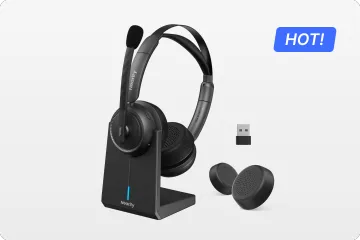
If your workday runs on calls, evaluate headsets by how you sound to others, not just how music sounds to you. A noise cancelling headphone with mic for office use is engineered around exactly that priority and is a sensible place to start your shortlist.
FAQs
Why do my headphones sound low quality on calls but fine for music?
Bluetooth headphones use a high-quality stereo profile (A2DP) for music, but switch to a lower-bandwidth hands-free profile (HFP) the moment the microphone activates, so everything sounds thinner.
A wired connection or a headset with a dedicated USB dongle avoids most of this drop.
What features define a headset with best microphone quality?
Look for a boom microphone that sits near your mouth, an array of three or four microphones for beamforming, AI-powered environmental noise cancellation (ENC), wideband or HD voice support, and a dedicated DSP chip.
Does turning up the volume make speech clearer on calls?
No. Speech clarity depends on frequency response and signal-to-noise ratio, not loudness. If a caller's voice lacks midrange detail or is buried in noise, more volume just makes unclear audio louder.
The fix is better microphone quality and noise suppression at the source.
Is ANC or ENC more important for business calls?
ENC is more important for calls.
ANC reduces the noise you hear through the earcups, which helps your focus. ENC cleans up the noise your microphone picks up, which determines how you sound to clients and colleagues. The best headset for business calls offers both, but prioritizes ENC.
Can one headset work well for both music and phone calls?
Yes, but only if it is engineered for both jobs: quality drivers and tuning for playback, plus a boom mic, multi-mic array, and ENC for calls.
Business-focused wireless headsets with hi-fi drivers are usually the best headphones for music and phone calls combined.




























![Happy young woman pointing sideways while wearing [Brand] over-ear wireless headphones](https://resource.auditoryworks.co/nearhub-v1/strapi/Happy_young_woman_pointing_sideways_while_wearing_an_over_ear_wireless_headphones_ed61b08adf/Happyyoungwomanpointingsidewayswhilewearinganover-earwirelessheadphones.jpg?x-oss-process=image/format,webp/resize,w_1024)