Bluetooth 5.3 vs 5.4 Differences: What Actually Changes for Business Headsets
Understand the real differences between Bluetooth 5.
Bluetooth 5.4
Wireless Headsets
Business Headsets
Updated: Aug 20, 2026 · 8 minutes read
Global Business, Brought Near.
No Installer, No Hassle, Just Works.
Bluetooth 5.4 sounds like a small upgrade from Bluetooth 5.3—but does that number actually make a difference when you are wearing a headset? The answer is more nuanced than a simple yes or no. This guide breaks down the real Bluetooth 5.3 vs. 5.4 differences, separates headset-relevant improvements from features designed primarily for IoT applications, and explains what you can actually expect in terms of connection stability, battery life, range, and device switching. It also looks at the Nearity EP320 to show how Bluetooth 5.4 translates into a more reliable experience for modern work calls.
Key Takeaways
Understand the key Bluetooth 5.3 vs. 5.4 differences and which new features actually matter for wireless headsets.
Learn how Bluetooth 5.4 can improve connection stability, power efficiency, range, and multi-device switching in everyday use.
Discover why features such as PAwR and EAD are important to Bluetooth 5.4 but have limited direct impact on headset audio.
See why Bluetooth version alone does not determine call quality—microphones, DSP, noise cancellation, codecs, and battery capacity matter just as much.
Find out when upgrading to a Bluetooth 5.4 headset makes sense and how the Nearity EP320 applies the technology to professional calls and meetings.
If you have shopped for a wireless headset recently, you have probably noticed a new number appearing in spec sheets: Bluetooth 5.4. It sits right next to the familiar Bluetooth 5.3, and the natural question is straightforward — does that increment actually matter, or is it just marketing?
The short answer: Bluetooth 5.4 brings real technical improvements, but not all of them apply to headsets. Some of the most talked-about features — Periodic Advertising with Responses and Encrypted Advertising Data — were designed for electronic shelf labels in retail stores, not for your next Zoom call. At the same time, Bluetooth 5.4 chipsets often deliver better connection stability, more efficient power management, and smoother multi-device switching than their 5.3 predecessors. These are precisely the things that make or break a business headset in daily use.
This article unpacks the bluetooth 5.3 vs 5.4 differences that actually matter for headsets, explains what Bluetooth 5.4 is, and helps you decide whether it should influence your next purchase. If you are a remote worker, an IT decision-maker, or simply someone who wants a reliable bluetooth headset wireless with mic for calls and meetings, here is what you need to know.
What Is Bluetooth 5.4?
Bluetooth 5.4 is a version of the Bluetooth Core Specification adopted by the Bluetooth Special Interest Group (SIG) in early 2023. It is not a generational leap like the jump from Bluetooth 4.2 to 5.0 was — instead, it is an incremental refinement within the Bluetooth 5 family that adds four specific features on top of what Bluetooth 5.3 already offered.
The four headline additions in Bluetooth 5.4 are:
Periodic Advertising with Responses (PAwR). This is the star feature of Bluetooth 5.4. PAwR enables bidirectional, connectionless communication between a central broadcaster and thousands of low-power devices. In practice, an access point can send data to hundreds of end nodes simultaneously, and each node can respond within its assigned time slot — all without establishing a formal connection. This is the technology behind the Electronic Shelf Label (ESL) profile, which lets retailers update pricing on thousands of digital shelf tags from a single access point. For headsets, this feature is largely irrelevant.
Encrypted Advertising Data (EAD). Prior to Bluetooth 5.4, there was no standardized way to encrypt data transmitted in advertising packets. EAD introduces a method for encrypting all or part of an advertising payload, and defines a GATT characteristic for sharing encryption key material. Again, this primarily serves IoT and ESL applications where data confidentiality matters in connectionless communication.
LE GATT Security Levels Characteristic. This feature allows a client device to determine upfront what security level is required to access all GATT attributes on a server, avoiding the user-experience friction of mid-session security prompts. While not a headline feature, it contributes to smoother device pairing and interaction.
Advertising Coding Selection. This gives the host more control over which Forward Error Correction coding scheme (S=2 or S=8) the controller uses for transmitting advertising packets. In practical terms, it improves range and reliability when devices are far apart or separated by obstacles — something that does matter for wireless headsets used across rooms.
Understanding these features helps clarify something important: the two most heavily promoted Bluetooth 5.4 capabilities — PAwR and EAD — were built for IoT and retail infrastructure, not for audio. The real question is what Bluetooth 5.4 means for the chipset inside your headset.
Bluetooth 5.3 vs. 5.4: What Are the Key Differences?
When comparing Bluetooth 5.3 and 5.4 side by side, the differences fall into two categories: features that are new in the specification, and real-world performance improvements that come from the newer chipsets implementing those features.
Aspect
Bluetooth 5.3
Bluetooth 5.4
Periodic Advertising with Responses
Not available
Available (bidirectional, connectionless)
Encrypted Advertising Data
Not standardized
Standardized encryption for advertising payloads
Connection Subrating
Introduced in 5.3
Enhanced with better parameter control
Advertising Coding Selection
Controller-driven only
Host-controllable (S=2 or S=8)
LE GATT Security Levels
Not available
Available (pre-negotiation of security)
Channel Classification
Introduced in 5.3
Carried forward, unchanged
Wi-Fi Coexistence
Good
Improved (newer chipset designs)
Power Efficiency
Moderate
Up to 10-15% better in idle
Bluetooth 5.3 was itself a meaningful update. It introduced Connection Subrating, which lets devices dynamically adjust how often they communicate without breaking the link — reducing unnecessary radio activity and saving battery on both the host and the peripheral. It also added Channel Classification, allowing peripherals to report which frequency channels are congested, so the central device can avoid interference.
Bluetooth 5.4 inherits all of these 5.3 improvements and builds on them. The enhanced Connection Subrating in 5.4 chipsets allows for more granular parameter adjustments mid-session. Earlier versions sometimes caused brief audio dropouts when adjusting data rates during a call; 5.4 handles these transitions more seamlessly.
The key takeaway from the bluetooth 5.3 vs 5.4 differences comparison is that 5.4 does not replace 5.3 — it layers additional capabilities on top of it. For a headset user, the most meaningful upgrades are the improved radio coexistence, the host-controlled coding selection for better range through walls, and the generally more efficient power management that comes with newer silicon.
What Does Bluetooth 5.4 Actually Change for Headsets?
This is the section that matters most if you are shopping for a business bluetooth headset. Let us separate what the specification says from what you will actually experience.
Connection Stability in Crowded RF Environments. Modern offices — and modern homes — are dense with wireless signals. Wi-Fi routers, smartphones, smart speakers, wireless keyboards, and neighboring Bluetooth devices all compete for the same 2.4 GHz spectrum. Bluetooth 5.4 chipsets incorporate improved coexistence algorithms that reduce packet collisions with Wi-Fi and other Bluetooth traffic. In practice, this means fewer audio dropouts during calls, even in an open-plan office with dozens of active devices, or in a home where multiple family members are streaming and gaming simultaneously.
Multi-Device Switching. Bluetooth 5.4 chipsets typically support multipoint connection more reliably than their predecessors. If you switch between a laptop for Zoom calls and a smartphone for incoming calls throughout the day, a 5.4 headset handles the handoff with less lag and fewer reconnection prompts. This is not a specification-level feature of 5.4 itself, but rather a benefit of the newer, more capable controller chips that implement it.
Battery Efficiency. Bluetooth 5.4's enhanced Connection Subrating allows the headset to spend more time in low-power states between active communication windows. The result is roughly 10-15% longer battery life compared to equivalent 5.3 hardware under similar usage patterns. For a headset that already delivers 35 hours of talk time, that translates to approximately 3-5 additional hours of calls — enough to get through an extra day of meetings without reaching for the charger.
Range and Obstacle Penetration. The Advertising Coding Selection feature in Bluetooth 5.4 lets the host explicitly choose S=8 coding, which generates more error correction data and extends effective range. While this primarily benefits advertising packets, the same chipset-level improvements in signal processing contribute to more stable connections at distance. A Bluetooth 5.4 headset is more likely to maintain a clean audio stream through two walls or across a 30-foot room than a 5.3 equivalent.
What Does Not Change with Bluetooth 5.4. It is equally important to be clear about what Bluetooth 5.4 does not directly improve. Audio codec quality is not tied to the Bluetooth version — both 5.3 and 5.4 support the same codecs, including SBC, AAC, and LC3 via LE Audio. Call clarity depends on the microphone array, the DSP chip, and the noise cancellation algorithm, none of which are determined by the Bluetooth version. A poorly designed headset with Bluetooth 5.4 will sound worse than a well-engineered headset with Bluetooth 5.2. The version number is one signal of quality, not the whole story.
If you are evaluating a bluetooth noise cancelling headset with mic for professional use, pay attention to the Bluetooth version, but pay equal attention to the microphone system, DSP processing, and battery specifications.
Is Bluetooth 5.4 Worth It for Your Next Headset?
For most business professionals, the answer is yes — but not because Bluetooth 5.4 is a revolutionary upgrade. It is worth it because Bluetooth 5.4 headsets represent the current generation of hardware, and that generation brings cumulative improvements that enhance the daily experience.
Consider these scenarios where Bluetooth 5.4 makes a tangible difference:
You work in an open-plan office or a busy coworking space. The improved Wi-Fi coexistence and connection stability in 5.4 chipsets mean fewer moments of "you're breaking up" during important calls. In a dense RF environment with dozens of competing signals, the margin between a stable connection and a dropped one is narrow, and 5.4 widens it.
You switch between a laptop and a phone throughout the day. Bluetooth 5.4 headsets handle multipoint switching with noticeably less friction. If you take a call on your phone while still connected to your computer's meeting software, the transition is faster and more reliable.
You move around your workspace during calls. Whether you pace during calls or step away from your desk to grab a document, the improved range and obstacle penetration of 5.4 chipsets keep your audio stream intact. Bluetooth 5.3 is good here; 5.4 is slightly better.
You want your headset to last as long as possible between charges. The incremental battery efficiency gains of 5.4 add up over weeks of daily use. If you are in meetings for 4-6 hours a day, shaving 10-15% off your power consumption means fewer interruptions to recharge.
If you are buying a new headset today and the price difference between a 5.3 and 5.4 model is modest, choosing 5.4 is a forward-looking decision. You are getting the latest silicon, the best coexistence algorithms, and the most refined power management. A noise cancelling headphone with mic for office that includes Bluetooth 5.4 gives you that margin without a significant premium.
That said, if you already own a Bluetooth 5.3 headset that works well for your needs, the 5.4 upgrade alone is not a compelling reason to replace it. The difference is incremental, not transformational. The headset's microphone quality, noise cancellation, comfort, and battery capacity all matter more than the Bluetooth version number.
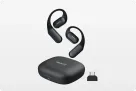
Nearity EP320: A Business Headset with Bluetooth 5.4
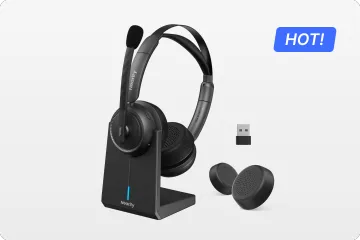
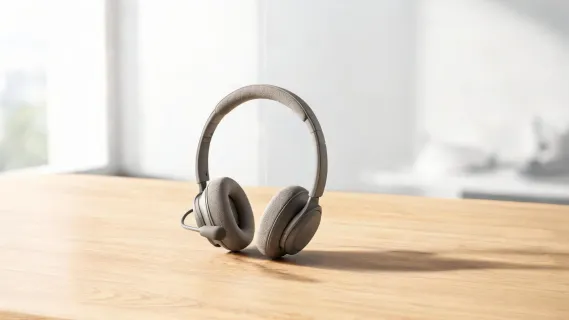
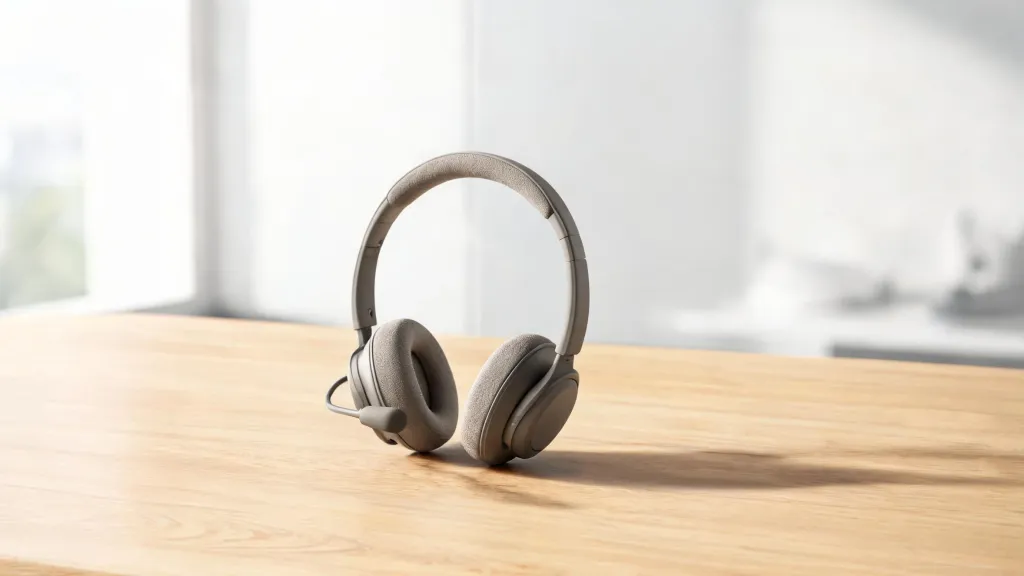
If you have decided that Bluetooth 5.4 is worth prioritizing, the Nearity EP320 is a practical option that puts the new standard to work in a business context. It is designed specifically for professionals who spend hours on calls and need a headset for work that delivers clarity, comfort, and reliability.
The EP320 runs on a Bluetooth 5.4 chipset, which means you get the connection stability, multipoint reliability, and power efficiency discussed throughout this article. It pairs simultaneously with two devices — a computer and a phone, for example — and switches between them without dropping the active connection. Whether you are taking a Teams call on your laptop and an incoming phone call interrupts, or you are listening to music on your phone and a meeting notification pops up on your computer, the transition is seamless.
For IT decision-makers evaluating a fleet purchase, the EP320 simplifies deployment. No software installation is required, firmware updates are straightforward, and the broad platform compatibility eliminates the "does it work with our stack?" question. For individual professionals, the EP320 is one of the best noise cancelling headset options in its price range — currently $127.50 — that combines Bluetooth 5.4 with serious call-quality engineering.
The Bluetooth 5.4 chip is not the only reason to choose the EP320, but it is part of a coherent design: a headset built for 2026 work environments, where calls happen in unpredictable acoustic conditions, and connection reliability is non-negotiable. The 5.4 silicon ensures the wireless link holds up; the four-mic ENC system ensures your voice comes through clearly on the other end.