If you are running a small or medium-sized business in 2026, you have probably noticed three letters appearing everywhere: ESG. Investors ask about it. Employees raise it in interviews. Customers factor it into purchasing decisions. But what exactly does ESG mean in business, and what does it mean for your business?
The good news: ESG is not just a Fortune 500 reporting framework. It is a practical approach to running a better, more resilient business. And the technology you use daily — including your meeting room tools — can directly support ESG goals while saving money and improving productivity.
This guide breaks down the ESG meaning in business into plain language, explains why 2026 is a pivotal year, and shows how workplace technology helps you make measurable progress on all three ESG pillars.
ESG Meaning in Business: Breaking Down the Three Pillars
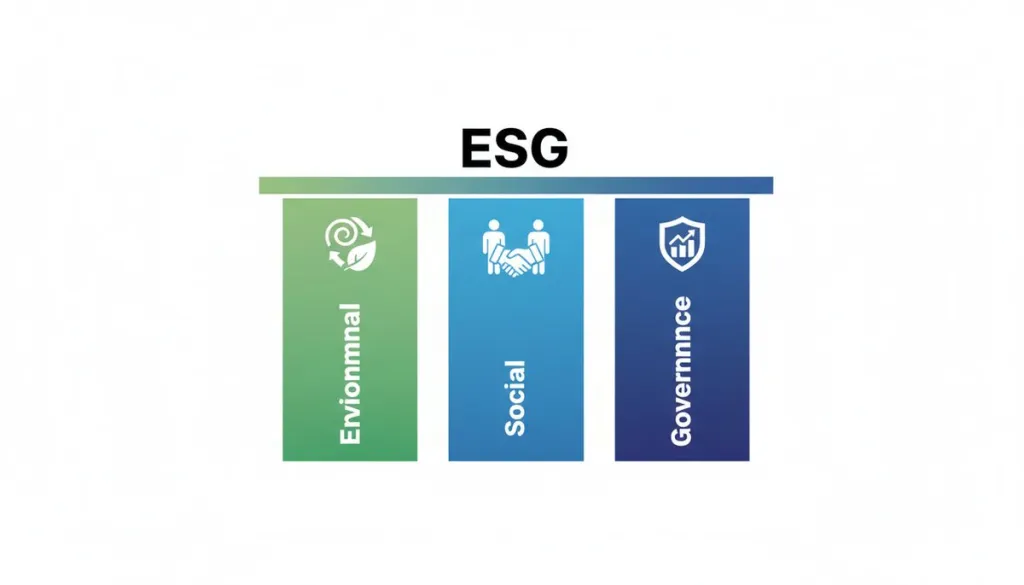
ESG stands for Environmental, Social, and Governance — the three interconnected pillars companies use to measure, manage, and improve their impact on the world around them. Think of it as a comprehensive scorecard for responsible business practices that goes beyond traditional profit metrics to include purpose, impact, and long-term sustainability.
Unlike corporate social responsibility (CSR) programs of the past, which often existed as separate charitable initiatives, ESG integrates responsible practices into core business operations and strategy. It asks not just "what good can we do with our profits?" but "how do our operations themselves create or destroy value for society and the environment?"
Environmental: How Your Business Impacts the Planet
For office-based businesses, this includes energy consumption, carbon emissions, waste generation, and procurement choices. Many environmental improvements also reduce costs — LED lighting cuts electricity bills, less paper saves on printing, and remote collaboration eliminates commuting emissions.
Social: How Your Business Treats People
This covers employee well-being, diversity and inclusion, community engagement, and supply chain ethics. In 2026, this pillar is especially critical as Gen Z and Millennial workers increasingly choose employers based on values alignment. A strong social track record is a powerful recruitment and retention tool.
Governance: How Your Business Operates
This refers to the systems that guide decision-making — ethical leadership, regulatory compliance, data security, and supply chain due diligence. Strong governance builds trust with investors and partners. For small businesses seeking loans, demonstrated governance maturity increasingly factors into due diligence assessments.
Why ESG Matters More Than Ever in 2026
ESG is not a passing trend. Several converging forces make 2026 a pivotal year for adoption — especially for small businesses.
Investors, Consumers, and Regulators Expect It
Global ESG assets are projected to reach $33.9 trillion by 2026. Investors increasingly view strong ESG practices as indicators of long-term viability. Consumers, particularly younger demographics, actively prefer responsible brands. Meanwhile, the SEC's climate disclosure rules and state-level mandates signal a regulatory trajectory that will eventually touch businesses of all sizes. Early adoption positions you ahead of future compliance requirements.
Talent Attraction and Retention Depend on It
The workforce of 2026 expects flexible arrangements, inclusive cultures, and demonstrated commitment to social and environmental causes. Companies that ignore ESG risk are losing talent to competitors who take it seriously.
ESG Improvements Save Money
Most ESG improvements also reduce costs directly. Less paper means lower printing bills. Energy-efficient equipment cuts utility costs. Remote collaboration reduces travel expenses. Healthier workplaces experience lower turnover. An ESG strategy, done right, functions as a cost optimization program — not a cost center.
Building Your ESG Strategy: A Step-by-Step Framework
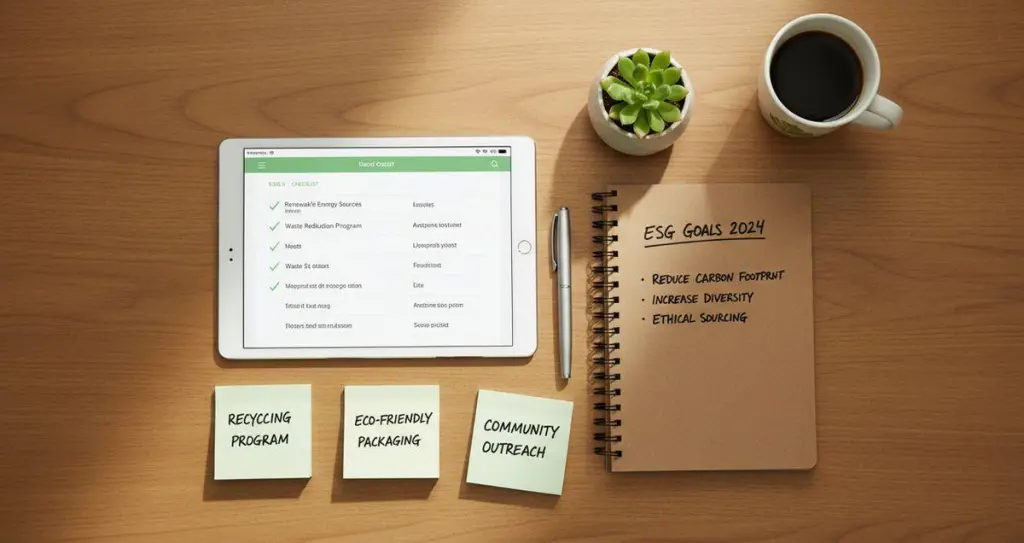
You do not need a dedicated sustainability department or a consulting budget to implement ESG. Here is a practical framework for small and medium businesses.
Step 1: Assess Your Baseline
Understand where you stand today across the three pillars:
- Environmental: How much paper and energy does your office use? How much business travel occurs?
- Social: What do employee surveys reveal? How diverse is your leadership?
- Governance: What policies cover data privacy, ethics, and compliance?
A rough baseline based on available data is infinitely more valuable than no baseline at all.
Step 2: Set Specific, Measurable Goals
Define concrete targets:
- Reduce paper consumption by 60% within 12 months
- Cut office energy usage by 25%
- Increase employee satisfaction scores by 30%
- Implement formal data privacy policies with 100% acknowledgment
Each goal needs a metric, a deadline, and an owner.
Step 3: Execute Quick Wins
Some improvements deliver immediate impact with minimal investment:
- Digitize meeting rooms with interactive displays to eliminate printed materials
- Replace aging projectors with energy-efficient LED displays
- Enable hybrid work with quality video conferencing to reduce commuting emissions
- Establish recycling stations with clear signage
- Switch to digital document workflows
Step 4: Measure and Iterate
Track metrics quarterly. Share progress internally and externally. Celebrate wins and honestly address slower areas. ESG is a continuous journey.
The Paperless Office
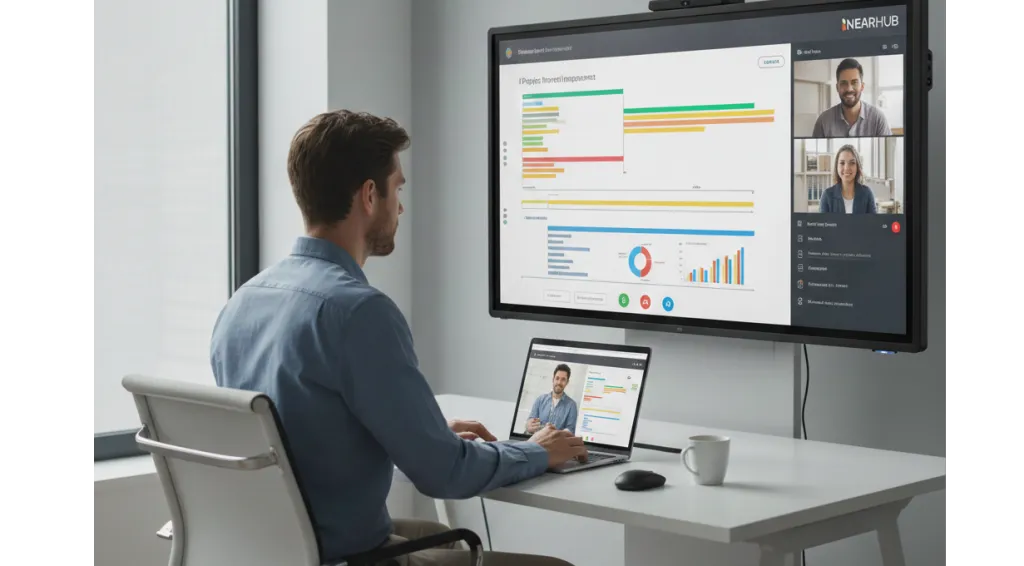
Organizations using interactive whiteboards report paper consumption reductions of 60-80%. Meetings and presentations occur on digital canvases that save automatically to the cloud — no printed agendas, handouts, or flip charts needed.

Energy Efficiency
Traditional projectors consume 200-300 watts, generate HVAC-straining heat, and require regular bulb replacements. Modern LED interactive displays use substantially less power, produce minimal heat, and operate 50,000+ hours without replacement. The savings across a multi-room office can reach thousands of dollars annually.
Reduced Travel Emissions
Business travel is a carbon contributor. High-quality video conferencing with interactive tools enables effective remote meetings that previously required flights and hotels. When remote participants can see, hear, and interact naturally, in-person presence becomes optional rather than mandatory.
Less Electronic Waste
All-in-one collaboration devices consolidate projectors, cameras, microphones, speakers, and computers into a single unit with one power connection and one eventual recycling event — reducing total electronics volume manufactured, shipped, and disposed of.
ESG for Small Business: Getting Started Without Overwhelm
ESG can feel intimidating, but it is a journey — not a certification exam.
Start With the Environmental Pillar
Most SMBs find environmental improvements the most accessible entry point because they are tangible and often save money immediately. Focus on reducing your office carbon footprint through paper reduction, energy efficiency, and smarter meeting technology. Every ream of paper you do not purchase and every kilowatt-hour you do not consume drops directly to your bottom line.
Use Technology as a Force Multiplier
Many productivity tools you may already be considering — digital collaboration platforms, cloud document management, modern video conferencing — simultaneously advance ESG goals. Frame technology decisions around both operational and environmental benefits.
Involve Your Team
ESG works best when collaborative. Ask employees what sustainability means to them. Form a volunteer green team to champion initiatives. When people feel ownership, they contribute creativity that no top-down directive can match.
Evaluate Total Cost of Ownership
Some ESG investments require upfront costs that pay back over time. An interactive smart board costs more initially than a whiteboard and projector, but consider the full picture: eliminated paper costs, reduced energy, avoided bulb replacements, less travel expense, and improved productivity. The total cost of ownership often favors the modern approach within 18-24 months.
Common ESG Mistakes to Avoid
- Treating ESG as marketing. Greenwashing damages credibility. Build real operational momentum first, then communicate externally.
- Setting unrealistic goals. Choose achievable targets, hit them, then raise the bar. Momentum matters more than dramatic announcements.
- Neglecting the social pillar. Environmental metrics are easier to quantify, but social factors often have the most direct impact on recruitment and retention.
- Choosing technology that creates new problems. Prioritize open-platform solutions with durable hardware rather than devices locked into closed ecosystems.
- Going it alone. Engage employees, discuss sustainability with suppliers, and share learnings with peer businesses.
Measuring What Matters
Track 5-8 metrics quarterly to keep ESG visible and drive improvement:
Environmental: paper usage, energy consumption, business travel emissions, waste diversion rate.
Social: employee Net Promoter Score, diversity ratios, retention rates, program participation.
Governance: training completion rates, security incidents, supplier vetting coverage, policy documentation.
When teams know progress is tracked and shared, behavior changes naturally. Simply reporting paper usage monthly often reduces consumption by 10-15% through increased awareness alone.
Your 90-Day ESG Action Plan
Days 1-30: Baseline and Quick Wins
- Measure paper, energy, and travel for the previous quarter
- Eliminate printed materials in all recurring meetings
- Install recycling stations with clear signage
- Schedule your first green team meeting
Days 31-60: Technology and Piloting
- Evaluate interactive displays for your highest-use meeting room
- Pilot paperless collaboration tools with one department
- Establish vendor sustainability criteria for future procurement
- Launch an employee awareness campaign
- Deploy digital collaboration tools in additional meeting spaces
- Calculate and communicate initial impact to stakeholders
- Draft a formal ESG policy for your employee handbook
- Set year-two goals based on actual performance data
FAQ: ESG in Business
What is ESG in business?
ESG stands for Environmental, Social, and Governance. Environmental covers carbon footprint, energy use, and waste. Social covers employee wellbeing, diversity, and community engagement. Governance covers ethical leadership, transparency, and compliance. Together, they provide a framework for responsible business operations.
Why does ESG matter for small businesses in 2026?
Investors, customers, and regulators increasingly expect responsible practices regardless of company size. With global ESG assets projected to reach $33.9 trillion by 2026, early adopters gain a competitive advantage, attract eco-conscious customers, reduce costs through efficiency, and position themselves for funding opportunities.
How can workplace technology help achieve ESG goals?
Interactive smart boards and digital collaboration tools reduce paper consumption by 60-80%, lower energy usage compared to older systems, and cut travel emissions by enabling effective hybrid meetings. All-in-one devices also minimize electronic waste by replacing multiple separate components.
What are the first steps to implement an ESG strategy?
Conduct a baseline assessment of your environmental impact, social practices, and governance policies. Set specific, measurable goals. Choose quick wins like digital collaboration tools and LED lighting. Assign ownership to team members and track progress quarterly.
How do interactive whiteboards reduce office carbon footprint?
They eliminate paper and printed materials. They replace energy-intensive projectors with efficient LED displays. They reduce business travel by enabling immersive hybrid collaboration. All-in-one smart boards further reduce electronic waste by combining display, camera, microphone, and computing into one durable device.
How much does ESG implementation cost for a small business?
ESG can start at virtually zero cost. Many initial steps require only behavioral changes. Technology upgrades like interactive smart boards typically pay for themselves through operational savings within 18-24 months. Start with no-cost initiatives, demonstrate savings, and reinvest into progressively more impactful investments.
Conclusion: Start Your ESG Journey Today
Understanding what ESG means in business is the first step. Acting on it is what separates leaders from laggards. In 2026, the tools and incentives for ESG adoption will be more accessible to small and medium businesses.
Start with a baseline assessment. Set three measurable goals for the next 12 months. Identify one technology investment — like upgrading your meeting room with an interactive smart board — that improves productivity while reducing environmental impact.
The NearHub Board Max is worth evaluating if your roadmap includes paperless collaboration, energy-efficient spaces, and inclusive hybrid work. With Windows 11 Pro, AI-powered immersive meetings, and enterprise security through Microsoft Intune, it addresses multiple ESG pillars through a single workplace upgrade.
The businesses that thrive in the coming decade will align profit with purpose. Your ESG strategy is not a side project — it is your competitive advantage in the making. The best time to start was yesterday. The second-best time is today.