


















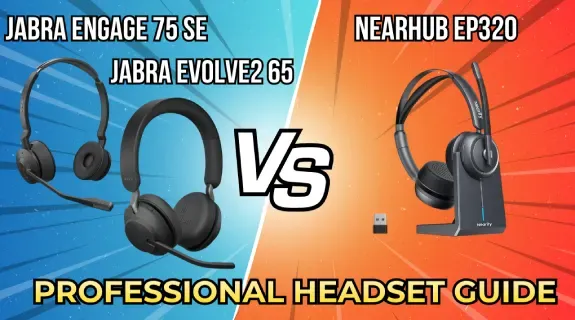
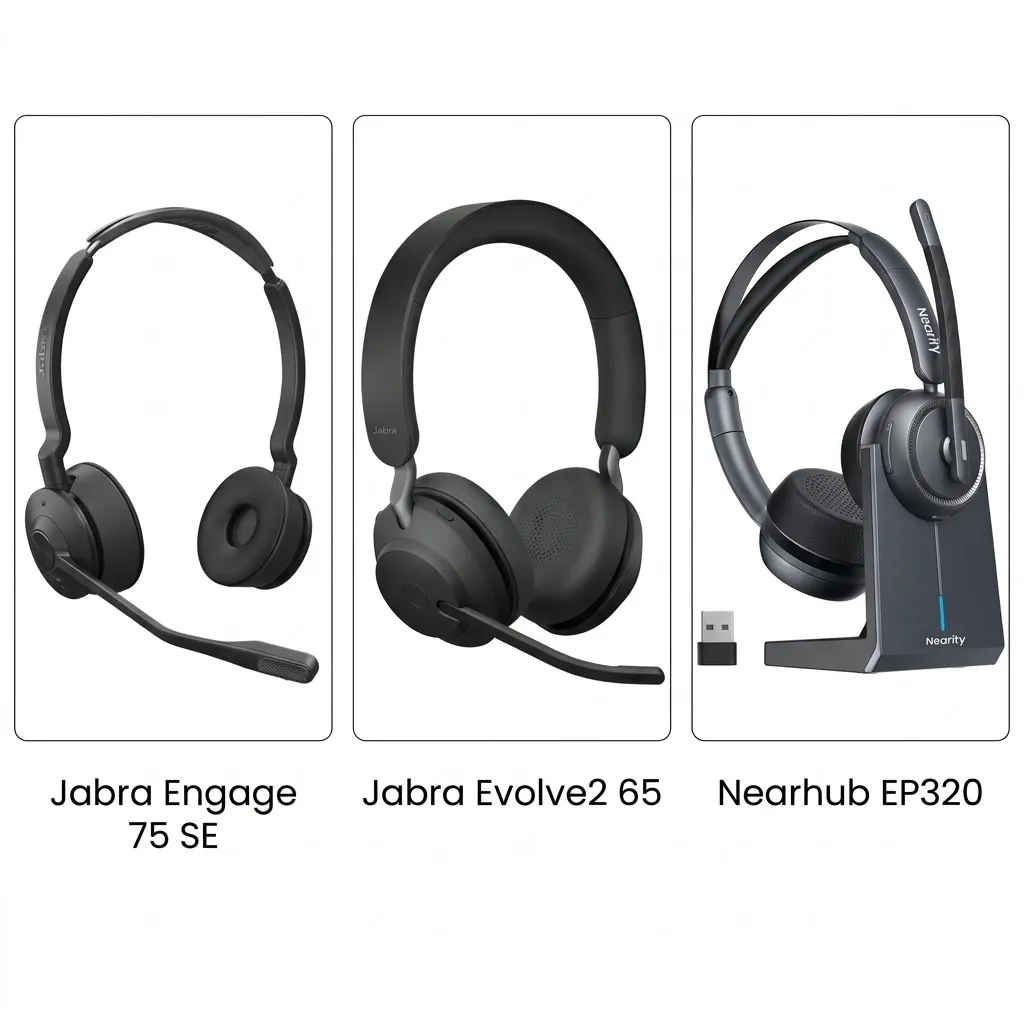
Confused by the difference between ANC and ENC? Not sure if you need Bluetooth 5.4 or DECT? You aren't alone. In 2026, choosing a headset feels more like buying a computer than an audio accessory. If you pick the wrong one, your clients might hear your kitchen blender instead of your presentation.
This guide clears the fog. We are comparing three heavyweights to show you exactly what you are paying for—and where the real value lies.
Quick Comparison
| Feature | Jabra Engage 75 SE | Jabra Evolve2 65 | Nearhub EP320 |
|---|---|---|---|
| Noise Tech | Advanced Digital NC(ANC) | Passive Noise Isolation | AI-Powered ENC (99.9%) |
| Protocol | DECT | Bluetooth 5.0 | Bluetooth 5.4 |
| Talk Time | 13 Hours | 35 Hours | 35 Hours |
| Mobility | Low (Tethered to Base) | High (Portable) | High (Portable) |
| Est. Total Cost | $402 | $362 | $127.50 |
Noise Cancellation Technology
As documented in Microsoft’s Work Trend Index on the evolving workplace, environmental distractions are a top barrier to hybrid productivity. Here is how these three models handle that noise.

⭐Nearhub EP320: AI-Powered ENC
- How it works: This is the 2026 standard. An AI chip runs a neural network trained on millions of audio samples to recognize human speech and mathematically delete everything else in real-time.
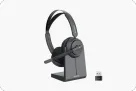
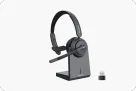
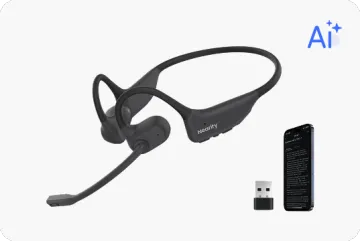
- Pros & Cons: The NearHub noise cancelling headphone for work -EP320 uses a HiFi5 DSP and a 4-mic array to achieve 99.9% background noise suppression.It ensures Total voice clarity for your caller. But no ANC for the wearer to block out the room.
⭐Jabra Evolve2 65: Passive Noise Isolation
- How it works: This relies on physical soundproofing. It uses high-density memory foam to create a tight seal around your ears.
- Pros & Cons: Great for helping you stay focused in a buzzy office. No AI "scrubbing"; if a sudden noise occurs, your caller will still hear it.
⭐Jabra Engage 75 SE: Advanced Digital NC(ANC)
- How it works: Uses traditional Digital Signal Processing (DSP) to identify and filter out steady, repetitive frequency bands like office AC units.
- Pros & Cons: Best for consistent office background chatter. Struggles with irregular, high-frequency "dynamic" noises.
Connectivity and Battery Life
Connectivity determines where you can work, and battery life determines how long.
| Feature | Nearhub EP320 | Jabra Evolve2 65 | Jabra Engage 75 SE |
|---|---|---|---|
| Protocol | Bluetooth 5.4 | Bluetooth 5.0 | DECT |
| Signal Hub | Device-based (Mobile) | Device-based (Mobile) | Fixed Base (Stationary) |
| Frequency | 2.4GHz | 2.4GHz | 1.9GHz |
| Talk Time | 35 Hours | 35 Hours | 13 Hours |
| Mobility | High | High | Low |
Bluetooth vs. DECT
- DECT (Jabra Engage 75 SE)
- The Hub: DECT requires a physical, plugged-in base station. The base acts as the fixed signal center; the headset only works within its range.
- The Frequency: It operates on a 1.9GHz private frequency. According to Federal Communications Commission (FCC) guidelines for Unlicensed Personal Communications Services, this band is reserved for voice, meaning it suffers zero conflict with Wi-Fi routers(2.4Hz).
- Capabilities: It is optimized strictly for voice communication. While it offers a massive range (up to 490ft) and total stability, it is not portable—you cannot connect it directly to a smartphone or take it to a cafe.
- Bluetooth (Nearhub EP320 / Evolve2 65)
- The Hub: Bluetooth is base-free. Your laptop or smartphone acts as the signal center.
- The Frequency: Operates on the 2.4GHz public frequency. Research published by the IEEE Xplore Digital Library confirms that Bluetooth can face interference in high-density environments where Wi-Fi also competes for the same 2.4GHz spectrum.
- Capabilities: It is a multi-functional tool. It handles voice calls, high-fidelity music, and data transfer. It allows you to switch seamlessly between music on your phone and a meeting on your PC.
✔The Jabra Engage 75 SE requires daily docking due to its 13-hour limit and reliance on its base. It is the gold standard for fixed-desk professionals who need maximum range and zero interference.
✔The Nearhub EP320 and Evolve2 65 are designed for mobility. They can survive a full work week on one charge and offer the flexibility to work from any location without being tethered to a physical base station.
Price and Budget
The "sticker price" only tells half the story. You have to look at what you get in the box and the software behind it.
Jabra Evolve2 65
- Headset: $301
- Stand: $61
- Total: $362
- Value: You are paying for the Jabra Ecosystem (Jabra Direct/Xpress), designed for large-scale enterprise IT management and remote updates.
Jabra Engage 75 SE
- Total (Base included): $402
- Value: High-security DECT technology and massive range for fixed-desk environments where interference must be zero.
Nearhub EP320
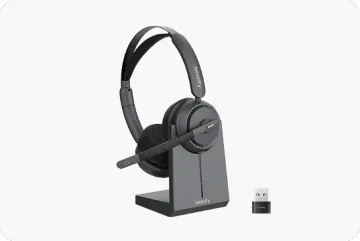
- Total (Stand & Dongle included): $127.50
- Value: High-performance professional wireless noise cancelling headset engineering; It delivers Bluetooth 5.4 and high-end noise suppression at a fraction of the legacy cost. Ideal for solo pros and small teams.
Jabra Engage 75 ($402) > Jabra Evolve2 65 ($362) ≈ 3 × Nearhub EP320 ($127.50)
Final Choice

By comparing price, tech, and connectivity, the winner depends entirely on your environment:
- Jabra Engage 75 SE ($402): This is an integrated DECT and ANC workstation headset for fixed environments. Best for executives or call center staff who need maximum call security and the ability to walk across the building while talking.
- Jabra Evolve2 65 ($362): This is a passive-isolation wireless headset built for the Jabra enterprise ecosystem. Ideal for corporate employees in quiet offices whose companies require remote IT management via Jabra Xpress.
- Nearhub EP320 ($127.50): A Bluetooth 5.4 professional wireless noise cancelling headset featuring AI-powered noise suppression for hybrid mobility. Perfect for agile professionals in homes or cafes who need noise cancelling headphone with mic tech to ensure caller clarity.
👉 Ready to experience AI-driven clarity? Explore the noise cancelling headphone for work and upgrade your professional audio today.
FAQs
Since Jabra Evolve2 65 is significantly more expensive, what exactly are its advantages?
Jabra’s core strength is enterprise software integration. As Jabra’s official documentation highlights, Jabra Xpress allows IT to manage thousands of devices remotely.
Is DECT (Jabra Engage 75) or Bluetooth 5.4 (Nearhub EP320) more stable for professional use?
It depends on your environment. DECT is superior for high-density offices where hundreds of people are on calls simultaneously, as it avoids the frequency interference that can affect Bluetooth. However, Bluetooth 5.4 is the 2026 standard for hybrid mobility. It offers faster pairing and Multi-point Connection, allowing you to switch between a laptop meeting and a mobile call instantly—something DECT cannot do without being tethered to its base station.
How does the Nearhub wireless noise cancelling headset-EP320 deliver enterprise-grade performance at such a highly competitive investment level?
Nearhub utilizes a "tech-first, legacy-second" strategy. By focusing investment on the HiFi5 DSP chip and AI algorithms rather than decades of traditional retail marketing, they’ve removed the "brand tax." The EP320 is designed to provide professional-grade AI noise cancellation and the latest Bluetooth 5.4 standards to individual pros and agile teams who prioritize performance over a legacy logo.
What is the difference between AI-ENC and standard Noise Cancellation?
This is a crucial distinction. Traditional NC (like in the Evolve2 65) often focuses on muffling sound for you, the wearer. AI-ENC (Environmental Noise Cancellation), found in the Nearhub headset for work-EP320, focuses on what your caller hears. Using a neural network, it identifies your voice and mathematically erases background chaos (dogs, coffee machines, traffic). In the 2026 remote work era, protecting your professional image on the other end of the line is the top priority.
What are the advantages of using the USB Dongle over built-in Bluetooth?
While built-in Bluetooth offers convenience, a dedicated USB dongle provides a specialized, interference-free channel. According to industry technical white papers on DECT vs. Bluetooth density, dedicated wireless endpoints prevent bandwidth congestion and audio drops common on shared built-in Bluetooth stacks.





 sales@nearhub.us
