The True Cost of a 65 Inch Smart Board (2026 Buyer's Guide)
This comprehensive blog explores the use cases, price and top models of 65 inch touch screen smart boards for 2026.
65 inch touch screen smart board
smart board 65 inch price
Updated: Sep 2, 2026 · 5 minutes read
Global Business, Brought Near.
No Installer, No Hassle, Just Works.
Key Takeaways
A 65 inch interactive touch screen under $1,500 is a display, not a meeting room — expect to spend $400–$800 more on camera, mic, and stand if collaboration is the real goal.
TouchWo, Elo, and Sharp 65 inch panels lead on price for signage and kiosks but run thin on whiteboard software, management, and warranty length.
NearHub S65 at $3,299 ships a built-in 4K camera and 24-mic array included, undercutting Promethean and SMART by roughly $200–$1,200 for the same conferencing class.
If you are reading this, you’ve probably already made the most important decision for your meeting room or classroom: choosing the best smart board size. A 65-inch screen is the golden standard for huddle spaces and medium-sized rooms accommodating 4 to 8 people.
However, when you search for a 65 inch smart board online, the results are incredibly confusing. You will see products priced at $700 right next to models priced at $4,500. Why is there a $3,800 price gap for boards of the exact same size?
In this guide, we will explain the real difference in pricing, reveal the true hidden costs of building a meeting room, and compare the top 5 models on the market right now.
The Two Types of Touch Screen Smart Board
When buying a 65 inch smart board, you need to know exactly what you are paying for. The massive price gap exists because there are two completely different types of screens on the market:
1. The Display-Level 65" Touch Screen ($700 – $1,500)
Best For: Retail displays, wayfinding, restaurant menus, digital signage, and basic light annotation.
The Catch: These are essentially giant tablets. While they are interactive, they do not include built-in meeting cameras or microphone arrays. If you put one of these in a conference room, you cannot host a Zoom or Teams meeting without buying extra equipment.
2. The Collaborative Smart Board ($2,500 – $4,500)
Typical Brands: NearHub, Promethean, SMART.
Best For: Hybrid meetings, remote collaboration, interactive teaching, and corporate brainstorming.
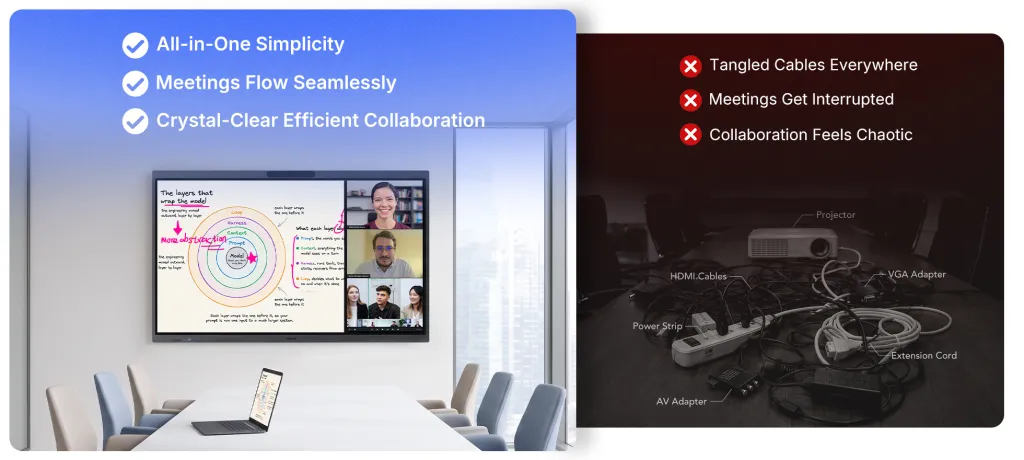
The Advantage: These are "all-in-one" ecosystems designed specifically for communication. They come equipped with high-end cameras, studio-quality microphones, and powerful built-in whiteboard software. You plug them in, and your hybrid meeting room is ready to go.
The Hidden Costs: Why Buying a "Cheap" Screen Can Cost You More
Many IT managers try to save money by buying a $1,000 basic display for their conference room. But let's look at the Total Cost of Ownership (TCO) when you try to turn a basic display into a hybrid meeting room.
What You Need
DIY Budget Setup (The "Cheap" Route)
All-in-One Smart Board
65" Touch Screen
~$1,000 (Generic basic display)
Included
4K PTZ Camera & Mic
~$500 (External webcam & speakerphone)
Included (Built-in)
Mobile Stand/Cart
~$300
Included/Optional
Whiteboard Software
$0 (Basic built-in apps)
Included (Professional Canvas)
Setup Experience
Cables everywhere, driver issues
Plug and play
Total Estimated Cost
~$1,800 + High IT Maintenance
See comparisons below
While the DIY route costs around $1,800, you are left with a messy table full of cables, mediocre audio pickup, and a frustrating user experience. On the other hand, traditional heavyweights will charge you $4,000+.
So, which specific models offer the best value for your budget?
65-Inch Smart Board Comparison Table (2026)
Here is a quick overview of how the top 7 models on the market stack up in terms of hardware, video/audio completeness, and pricing:
Brand & Model
Built-in Camera
Built-in Microphone
Target Primary Use
Estimated Price
NearHub S65
✅ Yes (4K AI, ~120° FOV)
✅ Yes (24-Mic Array)
Corporate Hybrid Meetings
$3,299 (promo)
Newline Q Series 65"
❌ No (Sold separately)
❌ No (Sold separately)
Education / Local Collaboration
$3,093(sale)-$4,599(MSRP)
Neat Board (65")
✅ Yes (Wide-angle 12MP)
✅ Yes (5-Mic Array)
Zoom/Teams Native Rooms
~$4,999
BenQ Board (RP6505)
❌ No (Sold separately)
✅ Yes (8-Mic Array)
K-12 Classrooms
~3,000–3,500 (est.)
NearHub Board Max 65
✅ Yes (4K AI, 130° FOV)
✅ Yes (8-Mic DSP Array)
Windows IT Environments
$4,499 (promo)
Clevertouch IMPACT
❌ No (Sold separately)
✅ Yes (Mic Array)
European Schools & Signage
~2,800–3,600 (est.)
Yealink MeetingBoard
✅ Yes (4K AI)
✅ Yes (16-MEMS Array)
Premium Video Conferencing
~$4,999 (US est.)
Detailed Breakdown: The Top 7 65-Inch Smart Boards Reviewed
1. NearHub S65 (Best All-in-One Value for Business)
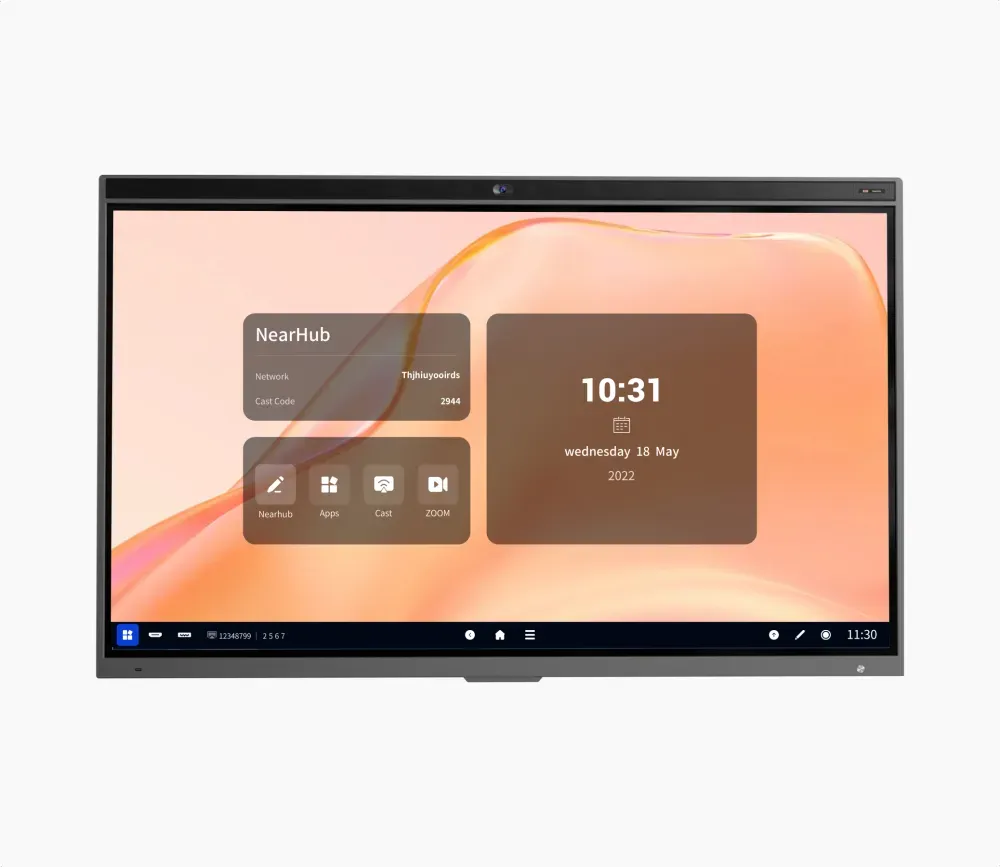
Why It Stands Out: The S65 is designed to eliminate cable clutter completely. It combines a studio-grade microphone system and an AI auto-framing camera into a single sleek unit. Unlike legacy brands approaching or exceeding $5,000 for video-conferencing-ready hardware, the S65 provides a complete hybrid meeting room out of the box for $3,299.
Best For: Small to medium corporate huddle rooms, executive offices, and hybrid team collaboration.
Why It Stands Out: Newline is a very popular brand in education and traditional offices. It offers a reliable writing experience and broad app compatibility. Promotional discounts can bring the price down nicely, though standard MSRP reaches up to $4,599.
Keep in Mind:It does not come with a built-in camera or microphone. To host hybrid video meetings, you must purchase and connect a separate webcam, speaker setup, or OPS computer.
Why It Stands Out: Neat offers a beautiful, minimalist design. It runs natively on Zoom Rooms and Microsoft Teams Rooms. Its built-in air quality sensors and acoustic noise suppression make it a top-tier choice for modern offices.
Keep in Mind: It is heavily locked into the Zoom/Teams ecosystem, and at $4,999, it sits right at the higher end of the pricing spectrum.
4. BenQ Board RP6505 (Best for Classrooms & Education)
Price:~$2,500 – $3,500
Key Features: 4K Touch Screen, Built-in Mics & Subwoofer, Air Quality Sensors, Google Play Store Access.
Why It Stands Out: BenQ excels in K-12 education. Its "ClassroomCare" technology protects students' eyes and health, while the Google certification allows teachers to download apps directly onto the board.
Keep in Mind: It includes microphones and speakers, but no built-in camera. You will need to mount an external camera for remote learning.
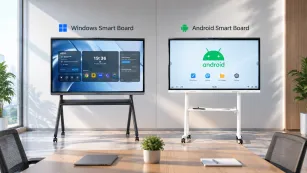
Key Features: Native Windows 11 Pro system (Intel 12th Gen i5 / 16GB RAM / 256GB SSD), Microsoft Intune support, built-in 4K AI camera & microphone array.
Why It Stands Out: While standard models run on Android, the Board Max 65 is built as a full Windows 11 Pro powerhouse. For corporate IT managers, it seamlessly integrates with Microsoft Intune for centralized device management, domain joining, and heavy enterprise application workflows without lagging.
Best For: Corporate IT departments, secure enterprise boardrooms, and teams requiring strict Windows-based software ecosystems.
6. Clevertouch IMPACT 65" (Best for UK/EU Schools & Signage)
Why It Stands Out: Clevertouch has a massive presence in European classrooms. It offers robust digital signage features (turning the board into a notice screen when not in use) and excellent lesson-planning software.
Keep in Mind: Like BenQ and Newline, the camera is an optional add-on, meaning it is better suited for local in-person teaching than out-of-the-box video conferencing.
7. Yealink MeetingBoard 65 (Best High-End Enterprise Video Board)
Price:~$4,999
Key Features: 4K Screen, Built-in 4K Camera with Privacy Shutter, Advanced Microphone Array.
Why It Stands Out: Yealink is a giant in the communications industry. The MeetingBoard 65 features impressive audio pickup and powerful AI voice tracking, making it exceptional for strict, formal video conferencing in larger rooms.
Keep in Mind: At over $5,200, it is the most expensive board on this list. Unless your company specifically requires deep Yealink ecosystem integration, its high price point is harder to justify for standard meeting rooms.
Use Cases: Where a 65 Inch Touch Screen Smart Board Truly Shines
Corporate Boardrooms & Conference Rooms
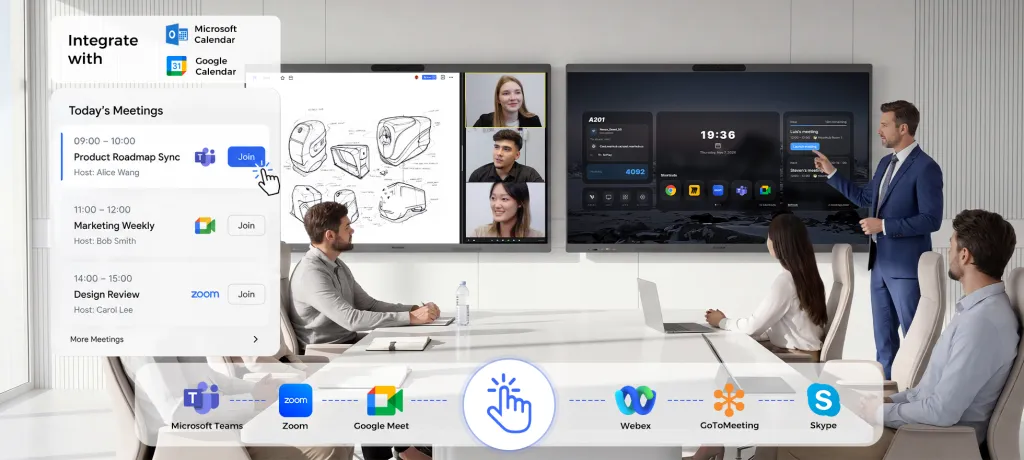
In corporate boardrooms, a 65-inch touch screen smart board transforms standard meetings into interactive strategy sessions. Team leaders can annotate charts in real time and highlight opportunities during financial reviews. During remote meetings via Zoom or Microsoft Teams, the built-in camera and microphone array provide high-definition video and crisp audio, ensuring everyone is heard and seen clearly.
Hybrid & Remote Work Environments
With hybrid work becoming the norm, smart boards bridge the gap between remote and in-office employees. Teams can wirelessly share screens and annotate visuals during live meetings. Since many smart boards are compatible with Zoom, Google Meet, and Microsoft Teams, they serve as all-in-one communication hubs, reducing the need for separate conferencing equipment.
In K–12 classrooms, teachers use 65-inch smart boards to display interactive quizzes, digital storybooks, science simulations, and real-time annotations. For instance, a biology teacher might dissect a digital frog on-screen, zooming in on organs while students interact with labels and definitions. In universities, professors can illustrate economic models or historical timelines and save the annotated versions for later reference.
Creative Studios & Design Agencies
Design teams benefit from the large canvas and precision input a 65-inch smart board provides. During creative reviews, team members can mark up drafts, compare visual options side-by-side, and interact with high-resolution mockups. A UX designer might walk stakeholders through a user journey on-screen, making live adjustments to wireframes.
Medical & Healthcare Facilities
Smart boards are increasingly being used in hospitals and clinics for collaborative case reviews, patient education, and administrative planning. Doctors can display X-rays or MRIs, annotate them live during consultations, and share findings with other specialists. In training hospitals, instructors use them for simulated diagnosis exercises or interactive medical lectures. Administrative teams can visualize patient flow charts, appointment schedules, and compliance reports for strategic planning.
Manufacturing & Engineering
For engineers and factory floor managers, a smart board provides an interactive way to review CAD designs, process flow diagrams, and performance metrics. Real-time data from sensors or IoT devices can be displayed on the board to help teams make rapid decisions.
Training Rooms & Professional Development
In HR departments and corporate training centers, smart boards facilitate engaging workshops, onboarding sessions, and compliance training. Trainers can launch videos, quizzes, and role-play scenarios directly from the board. Participants can take turns interacting with the content, whether it’s labeling diagrams or role-playing customer service responses.
Conclusion: How to Choose the Right Board for Your Space
Selecting the best 65-inch smart board comes down to your primary use case and IT infrastructure:
For K-12 Classrooms:BenQ and Clevertouch lead the pack with specialized health features, lesson-planning software, and local teaching tools.
For High-Budget Zoom/Teams Rooms:Neat Board ($4,999) and Yealink ($5,200) offer slick, native video conferencing experiences if budget is no object.
For Windows-Centric IT Environments: The NearHub Board Max 65 ($4,499) provides a true Windows 11 Pro enterprise experience with seamless Intune management and heavy-duty computing power.
For Complete Corporate Hybrid Meetings & Best Value: The NearHub S65 ($3,299) provides the best Total Cost of Ownership on the market—delivering built-in 4K AI video, a 24-mic array, and infinite whiteboard software without requiring extra cameras or inflated legacy brand pricing.
FAQs About 65 Inch Touch Screen Smart Boards
Q: Do I need to buy an external camera and microphone for a 65-inch smart board?
A: It depends on the model. Some smart boards (like the NearHub S65, Neat Board, and Yealink MeetingBoard) are "All-in-One" systems featuring built-in 4K cameras and microphone arrays ready for video calls out of the box. However, many traditional brands (such as Newline, BenQ, and Clevertouch) only provide the touch display and whiteboarding software, meaning you will need to purchase external webcams and microphones separately to host Zoom or Teams meetings.
Q: What is the Total Cost of Ownership (TCO) difference between modular screens and all-in-one smart boards?
A: While a basic touch screen might look cheaper at first glance (around $2,500 to $3,000), adding necessary accessories like 4K PTZ cameras, professional microphone systems, mobile carts, and OPS computers will usually push your total deployment cost to $3,300–$4,300, alongside messy cable management. All-in-one options like the NearHub S65 ($3,299) include everything out of the box, offering a lower TCO and a cleaner setup.
Q: What is the difference between Android-based smart boards and Windows-based smart boards?
A: Android-based smart boards (such as the NearHub S65) run on intuitive, lightweight operating systems that are fast, user-friendly, and perfect for quick wireless casting, local whiteboarding, and standard hybrid meetings. Windows-based smart boards (such as the NearHub Board Max 65, powered by Intel i5 and Windows 11 Pro) are designed for corporate IT environments, offering deep compatibility with Microsoft Intune, domain joining, and heavy enterprise application workflows.
Q: Why are some 65-inch smart boards priced at $2,500 while others cost over $5,000?
A: The price gap is driven by three main factors:
Integrated Hardware: Whether a high-end AI camera and multi-microphone array are built-in or require costly add-ons.
Computing Power & OS: Standard Android systems vs. high-performance Windows Pro PC modules.
Brand Ecosystem: Education-focused brands (like BenQ and Clevertouch) vs. corporate-focused enterprise solutions (like NearHub, Neat, and Yealink).