

















In today’s fast-paced hybrid work environment, saying goodbye to distractions is essential for staying focused and productive. Choosing the best office headset can make all the difference—especially when it comes to clear communication, effective noise reduction, and all-day comfort.
Many professionals find themselves deciding between a popular Logitech headset, including the well-known Logitech wireless headset series, and rising alternatives like the NearHub EP320. Each offers different strengths, from brand reliability to modern AI-driven performance.
This article provides a comprehensive comparison of both options, with a particular focus on mic clarity, comfort, and real-world noise control—key factors for anyone searching for a truly effective noise cancelling headset for work. Our goal is to help you make the smartest choice for your workspace and communication needs.
Key Takeaways
- Logitech is ideal for users who prefer an ANC-backed quiet workspace, offering reliable Hybrid ANC for focused work.
- NearHub EP320 delivers superior call clarity, using advanced AI ENC that removes up to 99.9% of background noise (typing, dogs barking, baby crying).
- Battery life differs significantly: Logitech lasts around 15–22 hours, while NearHub EP320 reaches 35–45 hours.
- Logitech leads in ecosystem and multi-device connectivity, especially with models using USB-C receivers for extra stability.
- NearHub EP320 offers stronger value for money, delivering comparable performance at nearly half the price of high-end Logitech models.
- Comfort varies by preference: Logitech uses softer cushioning, while the EP320 is lightweight and designed for long wear.
- The best choice depends on your workflow: For quiet concentration → Logitech; for crystal-clear calls and better value → EP320.
Product Overview: Getting to Know the Logitech Headset and the Nearhub EP320
Logitech Headset Series
Positioning and Audience: As a dominant force in computer peripherals, Logitech holds a massive market share by catering to every level of the professional spectrum. From entry-level employees to C-suite executives, there is a Logitech headset designed for nearly every budget and use case. Their products are positioned not just as hardware, but as part of a "Personal Workspace" ecosystem known for reliability and broad compatibility.
Key Models: The lineup is anchored by two distinct series. The Zone Wireless series (including the flagship Zone Wireless 2) targets the premium enterprise market with advanced features like active noise cancellation and replaceable parts. Meanwhile, the Zone Vibe series (such as the Zone Vibe 100/125) targets the modern hybrid worker with a lighter, lifestyle-focused aesthetic that blends home and office styles.
Core Advantages:
- Brand Reliability: Decades of engineering ensure these devices just work.
- Comfort: Premium models feature silicone and memory foam, while lifestyle models use breathable knitted fabric for all-day wear.
- Multi-Device Connectivity: Seamless switching between laptops and smartphones via multipoint Bluetooth is a staple of the Logitech wireless headset experience.

NearHub EP320
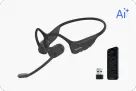
Positioning and Design Philosophy: The Nearhub EP320 (often branded under Nearity) enters the market with a laser focus on one critical problem: communication clarity in chaotic environments. Unlike Logitech’s broad lifestyle approach, the EP320 is engineered specifically as a professional tool for high-stakes video conferencing and support roles. It targets users who prioritize voice transmission quality and uptime over brand prestige.
Core Advantages:
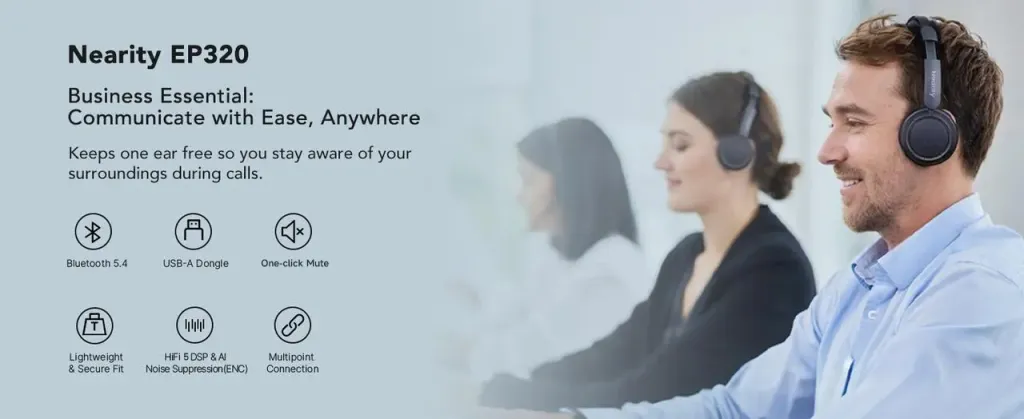
- AI Noise Cancellation: Its standout feature is the "AI-Powered ENC," driven by a dedicated HiFi5 DSP chip. This allows it to suppress non-stationary noise (like babies crying or dogs barking) with a 99.9% success rate.
- Ultra-Long Endurance: It addresses "battery anxiety" head-on with an industry-leading 35–45 hours of battery life, significantly outlasting most legacy competitors.
Core Comparison: Office Performance Showdown Between Logitech Headsets and Nearhub EP320
To determine which device reigns supreme, we must look at the metrics that matter most to the modern worker: audio clarity, silence, and endurance.
The Battle for Silence: ANC vs. ENC
The most critical distinction lies in how these headsets handle noise.
- Logitech Wireless Headset (Zone Wireless 2): Features Hybrid ANC. This means it uses microphones to actively cancel out background noise (like HVAC hum or airplane engines) for you, creating a quiet zone for deep work.
- Nearhub EP320: Focuses heavily on AI-Powered ENC (Environmental Noise Cancellation). While it effectively "deletes" background noise for the person you are talking to, it relies on "Passive Noise Isolation" (passive isolation) for the wearer. It will not actively silence the room around you like the Logitech does, but your voice will sound pristine to others, even in a coffee shop.
Battery Life and Endurance
For the road warrior, every hour counts.
- Logitech: The Zone Wireless 2 offers a respectable 15–22 hours of battery life depending on ANC usage.() The lighter Zone Vibe 100 offers around 18–20 hours.
- Nearhub: The EP320 is a marathon runner, boasting up to 35–45 hours of talk/music time on a single charge. This massive endurance advantage makes it ideal for shift work or long travel days where charging isn't an option.
Connectivity and Ecosystem
A Logitech wireless headset often justifies its price with connectivity. Models like the Zone Wireless 2 support Multipoint Bluetooth and come with a USB-C receiver that ensures rock-solid connections on Windows PCs, bypassing the often-flaky native Bluetooth stack. The Nearhub EP320 matches this utility by including a USB dongle in the box—a feature often omitted in budget headsets like the Logitech Zone Vibe 100—ensuring plug-and-play reliability for teams.
Comfort & Design: Aesthetics vs. "Zero Gravity" Ergonomics
When wearing a headset for an entire workday, ergonomics become as important as audio quality. The two brands take drastically different approaches to weight and materials.
- Logitech's Approach: Logitech splits its focus between "Executive Premium" and "Home Comfort."
- The Zone Wireless 2 (230g) exudes a premium feel with soft silicone headbands and plush leatherette ear pads. It is built to last with replaceable parts, but its weight is noticeable during marathon sessions.
- The Zone Vibe Series (185g) adopts a unique over-ear design using knitted fabric mesh. This material is highly breathable, preventing the heat buildup common with leatherette, and the over-ear fit ensures no pressure is placed on the ear cartilage.
- Nearhub's Approach: The EP320 prioritizes weight elimination above all else. Weighing in at approximately 145g, it is significantly lighter than its Logitech counterparts. It uses an on-ear design with protein leather memory foam cushions. While on-ear headsets can sometimes cause fatigue, Nearhub counters this with its "Zero Gravity" lightweight build and a low clamping force, making it designed specifically to disappear on the head for call-center-style shifts.
Key Analysis: Which One Truly Qualifies as the Best Office Headset for Work?
Defining the best office headset requires a nuanced look at three pillars: Noise Cancellation, Wireless Freedom, and Price-to-Value ratio. Here is how the contenders stack up in a direct head-to-head analysis.
Noise Cancellation: Balanced vs. Deep Suppression
The approach to noise is where these two brands diverge most sharply.
- Logitech (Balanced & Broad): The Logitech Zone Wireless 2 utilizes Hybrid Active Noise Cancellation (ANC). Its strength lies in its versatility. It features four modes (High, Low, Transparency, Off), allowing the user to control their acoustic environment. It is designed to be a "shield" for the wearer, blocking out server hums and office chatter to promote deep focus. While its microphone noise suppression is excellent, it aims for a natural voice tone rather than aggressive silence.
- NearHub (Deep & Targeted): The NearHub EP320 is a specialist. It employs a HiFi5 DSP chip to run Deep Neural Networks for Environmental Noise Cancellation (ENC). Its primary goal is "transmission purity." It is capable of suppressing 99.9% of non-stationary background noise (like a baby crying or a dog barking) from your microphone signal. If you work in a high-noise environment—such as a busy cafe or a house with children—the NearHub ensures the client never hears your chaos. For professionals seeking a noise cancelling headset for work that prioritizes clear outbound audio, it is the superior tool, even if it lacks the inbound silence provided by active ANC for the wearer.
Wireless Freedom: The Connectivity Ecosystem
A true Logitech wireless headset is defined by its ability to seamlessly traverse the digital workspace.
- Logitech: The Zone series excels in multipoint Bluetooth implementation. It allows you to connect to your laptop (for Teams calls) and your smartphone (for music/calls) simultaneously. The handover is polished; if a call comes in on your phone while you are listening to music on your PC, the audio switches automatically. Furthermore, the inclusion of the USB-C receiver in higher-end models guarantees a stable, interference-free connection up to 50 meters, solving the common "robotic voice" issues of standard Bluetooth.
- NearHub: The EP320 also supports multipoint connectivity, allowing for that essential laptop/phone duality. Where it truly shines, however, is in wireless endurance. With a battery life of 35–45 hours, it offers a level of freedom Logitech (at ~15-22 hours) cannot match. You can leave the charger at home for a 3-day business trip without anxiety. It creates a different kind of freedom—the freedom from the power outlet.
Price and Cost-Performance (ROI)
Who offers more value for your investment?
- Logitech: Priced at the premium end ($250–$299 for Zone Wireless 2), you are paying for the ecosystem, the build quality (replaceable battery/pads), and the comprehensive software management (Logi Tune). It is an investment in longevity and holistic features (music + work).
- NearHub: Priced aggressively ($120–$150), the EP320 offers a significantly higher ROI for users who strictly need a communication tool. You get industry-leading microphone noise cancellation and double the battery life for half the price. If you do not need the active noise cancellation for music listening, the NearHub is objectively the better value proposition.
Final Verdict and Buying Advice: Logitech Wireless Headset or Nearhub EP320?
The decision comes down to budget and use case.
Buy the Logitech Wireless Headset (Zone Wireless 2) if:
- You are an executive, developer, or creative who needs Active Noise Cancellation to focus on deep work.
- You are deeply invested in the Logi ecosystem and need features like remote management (Logi Sync) or Sidetone customization via an app.
- Budget is less of a concern than premium comfort and features.
Buy the Nearhub EP320 if:
- You need a noise cancelling headset for work strictly for calls and meetings, where your voice clarity is paramount.
- You want the "best bang for your buck." At roughly half the price of the Zone Wireless 2, you get superior battery life and a dongle included.
- You are a mobile professional who needs a headset that can last an entire work week on a single charge.
FAQs
- Does the Nearhub EP320 have Active Noise Cancellation (ANC) like the Logitech Zone Wireless?
No, not for the wearer. The Nearhub EP320 uses "AI-Powered ENC" to cancel noise for the microphone (so others don't hear your background noise), but it relies on passive isolation (the physical ear cups) to block noise for you. The Logitech Zone Wireless 2 has true Hybrid ANC that electronically silences background noise for the user.
- Can I connect these headsets to my phone and computer at the same time?
Yes, both headsets support Multipoint Bluetooth. You can pair them with your smartphone and your laptop simultaneously. This allows you to listen to music on your phone and automatically switch over when a Teams or Zoom call comes in on your computer.
- Do I need to install software to use the noise cancellation?
For Nearhub EP320, no. The AI noise cancellation is processed on the headset's internal chip, so it works plug-and-play on any device. For Logitech, while the basic features work out of the box, you often need the Logi Tune app to enable advanced features like "Advanced Call Clarity" and to customize the ANC/Sidetone settings.
- Which headset is better for all-day comfort?
This is subjective. The Logitech Zone Vibe 100 is an over-ear design, which many find more comfortable for long periods as it doesn't press on the ears. The Nearhub EP320 is an on-ear design but is significantly lighter (~145g vs 185g+), designed for "Zero Zoom Fatigue". The Logitech Zone Wireless 2 is heavier (230g) but uses premium materials for comfort.




 sales@nearhub.us
