
















In the professional landscape of 2025, the acoustic environment has ascended from a peripheral concern to a central pillar of infrastructure. As the global workforce solidifies into a hybrid equilibrium, the boundaries between the bustling corporate headquarters, the dynamic home office, and the transient "third spaces" have dissolved. This convergence has precipitated an "acoustic crisis" where the primary scarcity is not information, but attention.
The noise-cancelling headset has consequently transitioned from a luxury travel accessory to a piece of essential Personal Protective Equipment (PPE) for the knowledge worker's mind. It serves as the architect of the "fourth wall" in open-plan offices and the gatekeeper of professionalism in domestic workspaces. This report provides an exhaustive, data-driven analysis of the market in 2025, evaluating the technological advancements that define the optimal tools for professional focus.
Key Takeaways
- Noise cancelling headsets are essential for open offices, remote work, and hybrid teams to maintain focus and clear communication.
- ANC reduces ambient noise for the wearer; ENC ensures your microphone transmits a clean voice to others.
- Key factors when choosing a headset: microphone quality, comfort, battery life, connectivity, and UC/platform compatibility.
- Over-ear headsets excel in noisy environments; on-ear models are lighter and more comfortable for all-day meetings.
- Top 2025 picks include Nearity EP320, Poly Voyager Focus 2, Sony WH-1000XM6, Jabra Evolve2 75, and Bose QuietComfort Ultra.
- Boom microphones and AI-powered DSP noise suppression dramatically improve call clarity, even in chaotic environments.
- Multipoint Bluetooth and USB dongles provide reliable connectivity for hybrid work setups.
The Strategic Imperative: Why Noise Cancelling Headsets Matter for Work
In 2025, workplace communication depends on audio clarity more than ever. Whether you're in an open office, a hybrid schedule, or taking calls from home, noise has become one of the most underestimated barriers to productivity—and the right best noise cancelling headset for work can directly influence performance, meeting quality, and overall workflow.
The Productivity Penalty of Modern Workspaces
Open Offices
Research from the Harvard Business Review shows that employees in open-plan environments experience a 15% drop in productivity due to noise alone. Once interrupted, workers need an average of 23 minutes to regain deep focus, making it nearly impossible to achieve sustained “flow.” Workers also report feeling 66% less productive when they cannot escape noise, leading to higher error rates, slower processing, and reduced comprehension.
The Hybrid Paradox
While 52% of remote-capable employees now work in a hybrid model (Gallup), home offices are far from quiet. Household noise—from children, pets, appliances, or nearby neighbors—creates unexpected disruptions. On top of that, 67% of employees say remote meetings are difficult due to poor audio quality, contributing to mental fatigue and reduced engagement.
Why ANC + a Clear Microphone Are Critical for Meetings
Noise cancellation serves two essential functions:
- ANC (Active Noise Cancellation) for the wearer Reduces ambient noise so you can concentrate on calls, deep work, and virtual meetings.
- ENC / AI Noise Suppression for the microphone Ensures people on the other side don’t hear your environment—vital for Teams, Zoom, and Google Meet.
Studies reinforce the impact:
- 62% of office workers say noise directly affects their ability to focus (Jabra, 2024).
- Noisy environments lead to 17% longer call handling times (HBR).
- Poor audio quality results in lower productivity and reduced CSAT scores (Gartner, 2023).
In short: The best noise cancelling headset for work doesn’t only help you hear better—it helps others hear you better.
Who Benefits the Most From Noise Cancelling Headsets?
While everyone gains from better sound quality, certain roles benefit significantly:
- Customer support / call center agents
- Sales teams (SDR / BDR / AE roles)
- Remote workers in noisy home environments
- Open office employees
- Managers or executives who spend hours in meetings
- Content creators / streamers who need clean voice capture
If your work includes frequent calls, presentations, or customer conversations, a strong ANC headset and a premium microphone are no longer optional—they’re essential.
How to Choose the Best Noise Cancelling Headset for Work
Choosing the right headset is easy when you understand the technologies behind noise cancellation. Below are the key factors to watch for, especially when selecting the best noise cancelling headset with mic for professional environments.
ANC vs ENC — Which Matters More for Work?
Many consumers conflate Active Noise Cancellation (ANC) with Environmental Noise Cancellation (ENC). A high-performance work headset must excel at both, or specialize in the one you need most.
| Feature | Active Noise Cancellation (ANC) | Environmental Noise Cancellation (ENC) |
| Primary Beneficiary | The Wearer (You) | The Listener (The Client/Colleague) |
| Core Function | Blocks incoming ambient noise (engines, HVAC) so you can focus. | Filters outgoing microphone audio so they hear your voice, not your dog. |
| Mechanism | Uses mics to sample noise and generates "anti-noise" to cancel it before it hits your eardrum. | Uses beamforming mics and AI algorithms to isolate human speech and suppress background chaos. |
| Best Use Case | Deep work, commuting, air travel, noisy open offices. | Sales calls, customer support, coffee shop meetings. |
Microphone Quality & Noise Suppression Technology
- The Boom Arm Advantage: Physics dictates that placing the microphone closer to the mouth improves the Signal-to-Noise Ratio (SNR). Enterprise headsets (Poly, Jabra, Nearity) use boom arms to naturally isolate voice.
- AI & DSP Power: The biggest leap in 2025 is the use of dedicated DSP (Digital Signal Processing) chips. Devices now run neural networks directly on the headset to identify and strip out non-stationary noise (like a baby crying or keyboard clacking) in milliseconds.
Comfort, Battery & Connectivity
The “8-Hour Wear” Test:
On-ear headsets are typically lighter and more breathable, reducing heat buildup and neck strain during long workdays. Over-ear models provide better passive isolation but may feel heavier during extended use.
Connectivity:
For professional workflows, a USB dongle is essential. It provides a significantly more stable connection than standard Bluetooth and supports the higher-bandwidth audio required for platforms like Teams and Zoom. To avoid audio issues, look for:
- Microsoft Teams certification
- Zoom certification
- Google Meet optimization
- UC compatibility
- Plug-and-play ENC for consistent cross-platform performance
These ensure:
- Echo-free calls
- Consistent microphone clarity
- No software conflicts
- Smooth performance in virtual meetings
Multipoint:
The ability to connect to a laptop and smartphone simultaneously is essential for the hybrid worker switching between VoIP calls and mobile calls.
Top 5 Best Noise Cancelling Headsets for Work in 2025
Based on technical specifications, microphone performance, and value, these are the top selections for the modern professional.
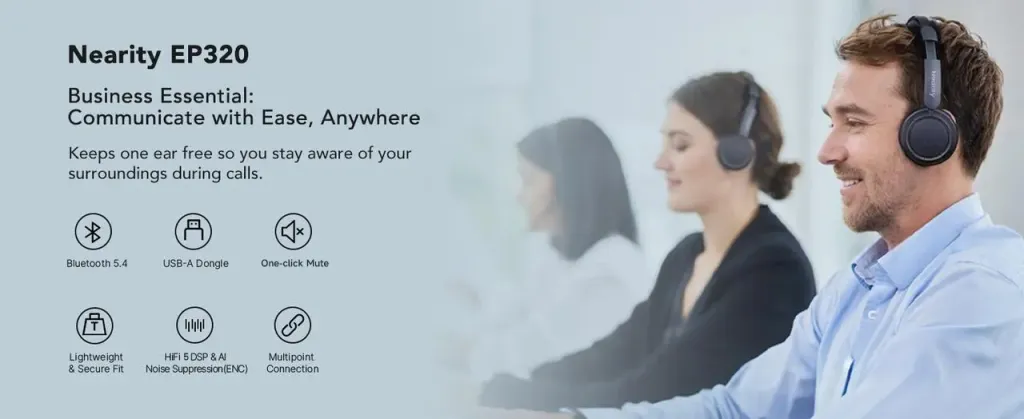
Nearity EP320
Best For: Best Value Professional Headset (ENC Specialist) The disruptive newcomer that brings enterprise-grade call clarity to a mid-range price point using advanced AI.
- Short Summary: While big brands rely on expensive hardware, Nearity leverages a powerful HiFi5 DSP chip to run deep-learning algorithms. This allows the EP320 to suppress 99.9% of background noise for the listener, rivaling headsets three times the price.
- Key Features:
- AI-Powered ENC: 4-microphone array driven by neural networks to eliminate non-stationary noise (babies, barking, typing).
- Battery Beast: Industry-leading 35 hours of talk time and 45 hours of music playback.
- Connectivity: Bluetooth 5.4 with a dedicated USB Dongle for stable PC connection and multipoint pairing.
- Pros: Superior microphone clarity for the price; massive battery life eliminates "charge anxiety"; lightweight (184g) with a professional charging stand included; flip-to-mute boom arm.
- Cons: Uses passive noise isolation for the wearer rather than Active Noise Cancellation (ANC)—great for talking, less effective for blocking out a jet engine while listening to music.
- Price: ~$149 (Often available for less)
Sony WH-1000XM6
Best For: Deep Focus & Travel The definitive tool for the "individual contributor" who prioritizes silence above all else.
- Key Features: Industry-leading ANC via the QN3 processor, 30-hour battery, over-ear design.
- Pros: Unmatched isolation from office chatter; exceptional comfort for long sessions; "studio" sound quality.
- Cons: No boom arm means microphone quality, while good, lags behind dedicated enterprise headsets in extreme noise; expensive.
- Price: ~$429
Poly Voyager Focus 2
Best For: The "Power User" (Sales/Execs) The gold standard for those who spend 6+ hours a day on calls.
- Key Features: "Acoustic Fence" technology creates a virtual bubble around the mic; ultra-lightweight (175g) on-ear design.
- Pros: Incredible noise rejection for the listener; DECT/Bluetooth hybrid options available; extremely comfortable sling headband.
- Cons: On-ear design isolates less noise for the wearer compared to over-ear models; industrial look.
- Price: ~$329
Jabra Evolve2 75
Best For: The Hybrid Professional Bridging the gap between a consumer headphone and a call-center tool.
- Key Features: Retractable boom arm that hides away; "Dual-foam" ear cups for passive isolation; adjustable ANC.
- Pros: Versatile design looks good on the subway and on Zoom; excellent Microsoft Teams integration; solid ANC performance.
- Cons: Heavier than the Poly Focus 2; boom arm mechanism can be fragile over years of use.
- Price: ~$349
Bose QuietComfort Ultra
Best For: Comfort & Glasses Wearers The ultimate choice for comfort and physical isolation.
- Key Features: Legendary Bose ANC; plush ear cushions; immersive audio mode.
- Pros: The most comfortable headset for glasses wearers due to soft clamping force; erases low-frequency drone better than any competitor.
- Cons: No boom arm (uses beamforming mics); cannot connect via USB for audio (analog/Bluetooth only).
- Price: ~$429
Final Recommendations: Which Headset is Best for You?
Best for Open Office Noise & Sales Teams
Winner: Poly Voyager Focus 2 or Nearity EP320. If you are talking all day, you need a boom mic. The Poly is the proven enterprise choice, but the Nearity EP320 is the "smart money" pick for 2025. By using AI to clean up your audio, Nearity delivers similar call clarity to the premium brands at nearly half the cost, with significantly better battery life (35 hours vs 19 hours). It is ideal for equipping large teams or for remote workers on a budget who cannot compromise on voice quality.
Best for Deep Work & Concentration
Winner: Sony WH-1000XM6. When you need to write code, draft reports, or think deeply in a chaotic environment, Sony's QN3 processor offers the best "cone of silence" for your own ears.
Best for Comfort & Glasses Wearers
Winner: Bose QuietComfort Ultra. The plush ear cups deform perfectly around spectacle frames, allowing for all-day wear without the "temple crush" headache associated with tighter headsets.
Best for Customer Support / Call Centers
Winner: Poly Voyager Focus 2. The dedicated boom mic and advanced noise suppression are specifically designed for high-volume, professional voice communication, ensuring clear interaction with every customer.
FAQs
- ANC vs. ENC: Which do I need for a home office with kids/pets?
You need ENC (Environmental Noise Cancellation). While ANC will help you ignore the noise, only a headset with high-quality ENC (like the Nearity EP320 or Poly Focus 2) will prevent your client from hearing the dog barking or baby crying. These headsets use boom mics and AI to surgically remove those sounds from your audio stream.
- Is the Nearity EP320 worth it compared to "Big Brand" headsets?
Absolutely. In 2025, audio quality is often determined more by software (AI algorithms) than just hardware. The Nearity EP320 utilizes the HiFi5 DSP to punch well above its weight class. If your priority is outgoing voice clarity and battery life—and you don't mind sacrificing active noise cancellation for your own ears—it offers the best price-to-performance ratio on the market.
- Are over-ear or on-ear headsets better for work?
Over-ear: Better for noisy environments, as they provide stronger noise isolation, but they tend to be heavier and warmer.
On-ear: Lighter and more comfortable for long meetings, making them ideal for all-day wear, though they offer less noise isolation.
- What is the difference between headphones and a headset for work?
Headsets are specifically designed with high-quality, professional-grade microphones (often on a boom) and are UC certified. Headphones (like the Sony WH-1000XM6) prioritize music quality and usually have less effective built-in microphones for voice calls.




 sales@nearhub.us
